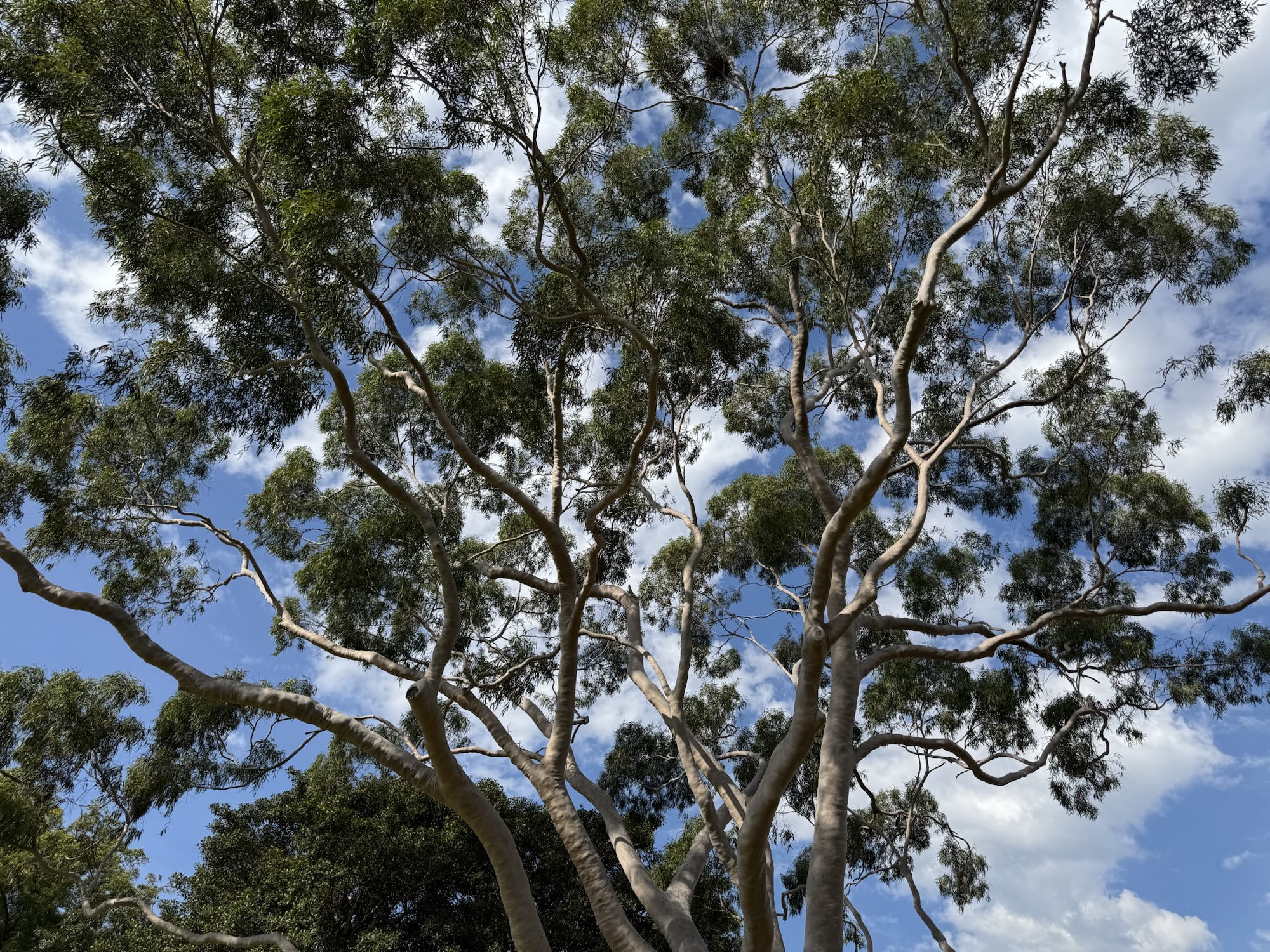
The lemon-scented gum is a fabulous tree in my eyes-mainly because of the form the tree has when mature.

The binomial name, Corymbia citriodora, comes from both Greek and Latin, as follows:
- Corymbia-comes from the Latin word ‘corymbium’ that means ‘corymb’ which is a type of flower cluster.
- Citriodora-a word of Greek origin that means ‘lemon-scented’. The lemon scent comes from the leaves of this tree.
The common name of lemon-scented gum is self explanatory, again because of the leaves.
A tall tree that can reach up to 40-50m in its native range and 20-30m in cultivation, the lemon-scented gum is a smooth-barked tree. Its native habitat is dry schlerophyll open forest and woodland on the dry ridges and plateau of coastal, sub-tropical Queensland between Cooktown and Gladstone. The tree tolerates many types of soil but performs at its best in sandy loam or gravelly soils.
Heteroblasty is a feature of trees in this genus. It means that the leaves have a different form between juvenile and adult forms of the tree. With the juvenile leaves, the margins (leaf edges) are wavy with a sandpaper texture over the leaf surface and arranged oppositely along the stem. The adult leaves are smooth, long, narrow and up to 21cm long. Adult are arranged alternately along the stem. they are a fairly dark green in colour and contain oil glands that give the leaves their scent.


The flowers are typical of the Myrtaceae family. The flowers have their conspicuous white stamens (although I don’t have any flowers at the moment for this species) and reach to 2cm across. The flowers appear in clusters of three at the terminus or the stems/branches. The tree flowers from winter to spring. Flowers are followed by urn-shaped fruits that contain the red to black seeds.
The smooth bark of the tree can vary in colour from white, pink and red to coppery and blue-grey. As with many other gum trees, the light can bring out interesting colours within the bark too, especially around dawn and dusk, which makes the bark one of my favourite features of this tree. The bark also ‘wrinkles’ where there are any curves and bends in branches, etc.


This tree is a great feature tree, provided that you have a significant amount of space-it really isn’t a small tree. It is ideal for very large gardens and parks. There is caution needed with this tree, as they can drop branches in certain conditions. It is a tree that grows easily from seed-sow into containers with root training structures that supports the growth of a well-structured root system.
The tree grows very straight growth, that produces strong, structural timber that is used for things like beams, bridges, poles and flooring. Other uses of this tree includes the flowers for honey production, and the volatile oil gets used in cosmetic, medicine and insect repellent production. It’s also useful in revegetation projects.
An issue with the lemon-scented gum is that it can become weedy outside its natural range. It is a very fertile tree-at work I have seen so many seedlings dotted around the area from two trees of this species. Due to its ability to produce seeds that germinate prolifically, the species has naturalised in the states of Western Australia, Victoria, South Australia and New South Wales.
I do love these trees personally. They are massive, great looking trees for large landscapes with lovely smelling leaves. They do need to be used with caution, but that’s the same with any large tree!
Https:resources.austplants.com.au/plant/corymbia-citriodora
Https://plantnet.rbgsyd.nsw.gov.au/cgi-bin/nswfl.pl?page=nswfl&lvl=sp&name=corymbia~citriodora
https://www.anbg.gov.au/gnp/trainees-2016/corymbis-citriodora.html
All photos are my own
One response to “Lemon-scented gum-Corymbia citriodora”
[…] working around a few lemon-scented gums (Corymbia citriodora). You can read more about this tree here if you would like to know […]