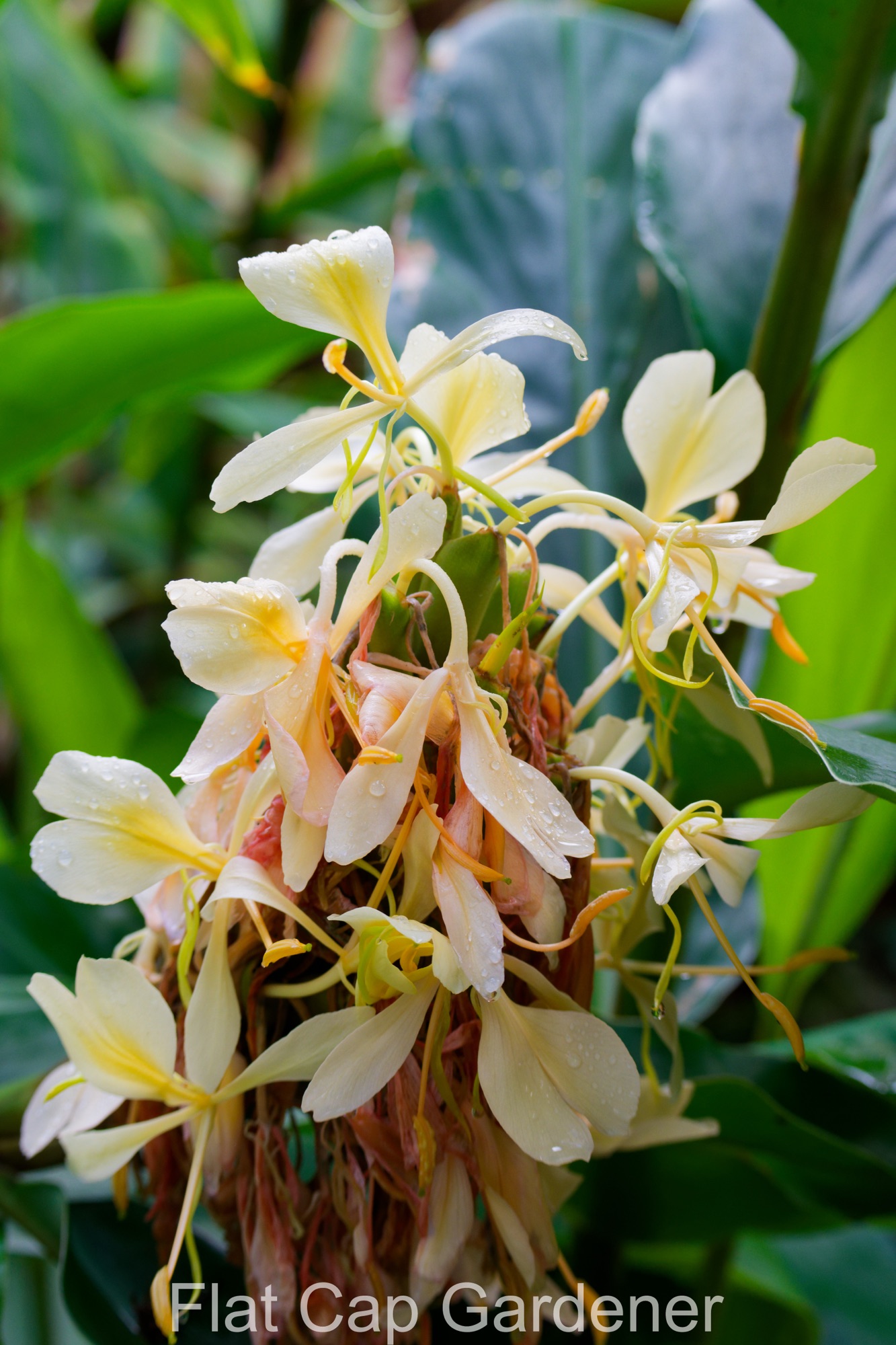
The yellow ginger lily is a herbaceous perennial that forms a cluster of stems that grow to between 1-2.5 metres tall. These stems grow from a rhizome that is thick and fleshy. This rhizome spreads outwards over time to form a thick mat which prevents any other plant from growing within its growing area. The meaning for the binomial name, Hedychium flavescens is as follows:
- Hedychium comes from two Greek words ‘hedys’ which means sweet and ‘chion/chios’ meaning snow. This is in reference to the white flowers on the type species for the genus, Hedychium coronaries.
- Flavescens comes from the Latin word ‘flavus’ meaning yellow.

The native range of yellow ginger lily is Assam (NE India), south-central China, east Himalaya, Myanmar, Nepal and Vietnam. It belongs on the Zingiberaceae family. The native habitat of this species is rainforest, river banks and disturbed areas. When growing, it prefers high rainfall areas between 1000-5000 mm each year, and an elevation of up to 2000 metres above sea level. It likes more open environments with plenty of light, with warm and humid climates. Foil needs to be very fertile.
The flowers appear in flower heads that can reach 45 centimetres long. They are pale yellow and perfumed. The flowers are followed by 3-valved capsules that contain bright red fleshy seeds to 1.8 cm long.

These lovely flowers appear in summer and autumn.

The leaves are arranged alternately. Each individual leaf is up to 45 cm long by 15 cm wide. There is a membranous ligule reaching three centimetres long.

Here in Australia, the yellow ginger lily is considered a weed. In both Queensland and New South Wales, it has been classed as an environmental weed. Across the world, it is considered one of the top 100 worst invasive weeds.
It is considered a weed because of the fact that it forms dense stands where nothing else grows. The rhizomes can also grow to one metre in depth. The stands of yellow ginger lily smothers the understory of the forest (if growing on one) and stops other plants from being able to establish themselves, thus changing the habitat present for the worse. It is also really poisonous to livestock.
I usually ask myself whether I would have a plant I’m talking about in my garden. In this case, I don’t have to ask that because it would not come anywhere near a garden of mine. I do like the tropical look to the plant and the yellow flowers. The big but is that if you have ever tried to remove such a plant from the garden, it is really difficult work. The effort isn’t worth it, no matter how pretty the flowers.