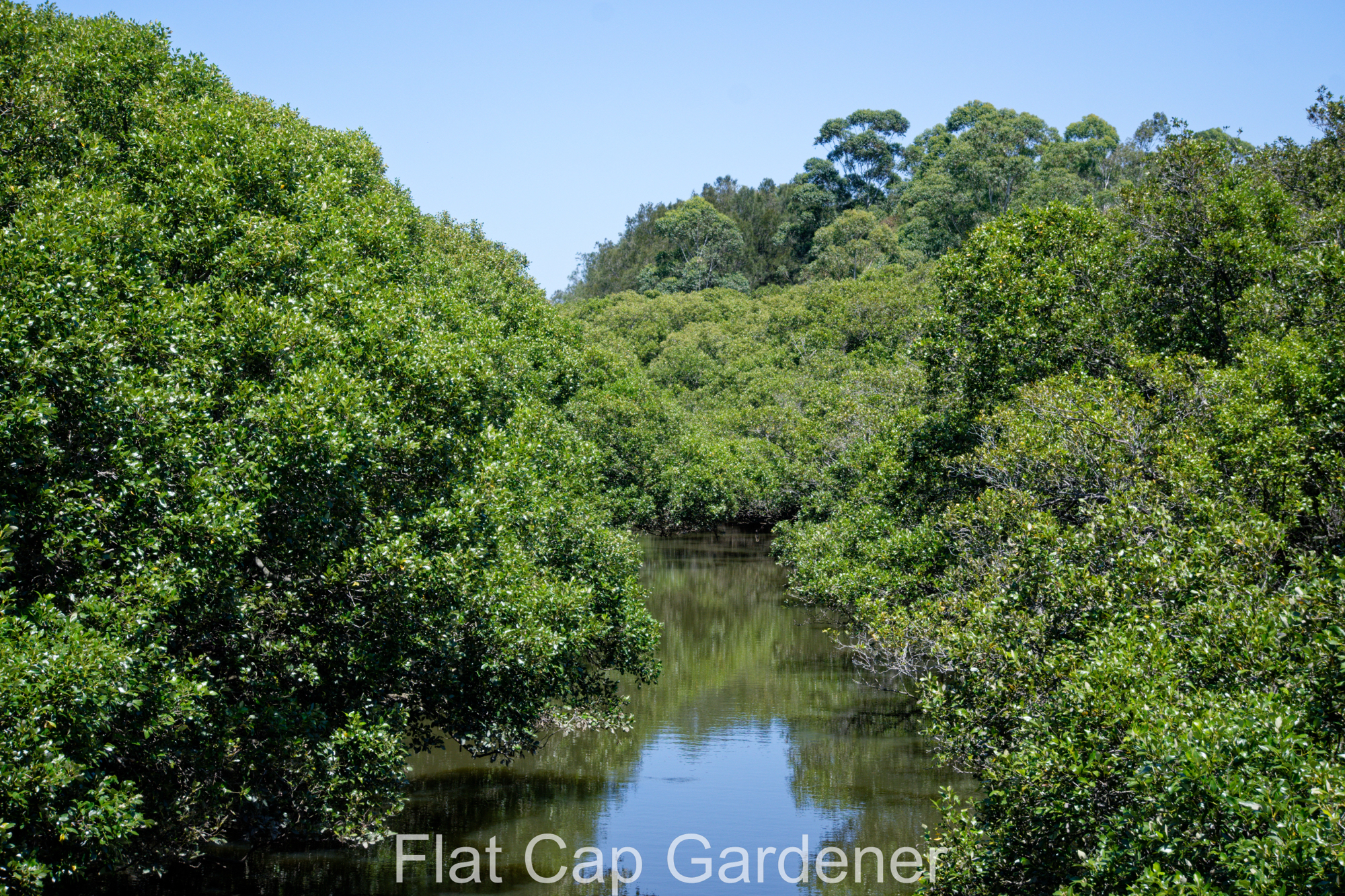
The grey mangrove, or Avicennia marina var. australasica, is a tree that resides in the intertidal areas of estuaries, with species in particular being present in coastal areas of every Australian state, along with with New Guinea, south-east Asia and the Pacific Islands. It thrives in areas of brackish water in these areas. The common name, grey mangrove, is because the undersides of the leaves are grey or because of the colour of the timber. The binomial name, Avicenna marina var. australasica has the following meanings:
- Avicennia-used of the Persian philosopher Ibn Sina (980-1037), who was known as Avicenna in Europe. His cannon of medicine cap trained many herbs unknown in Europe during his lifetime.
- Marina-a Latin word that means ‘of the sea’
- Var.-short for variety, which is used to describe the slight natural variation in botanical structure
- Australasica-defines a plant that calls Australia, Pacific Islands, New Zealand and New Guinea home, depending on the individual species.

The grey mangrove is a small tree, up to ten metres tall. It is found growing in pure stands of the same species. They have pneumataphores which are special roots that poke above the soil, and the waterline, to allow oxygen absorption-this oxygen gets transported to the roots underground. The roots also have pores that filter out salt as water is absorbed through them. They do this because they need fresh water to survive, even though they live in a brackish environment.

The leaves are in an opposite arrangement on the branches. They reach up to 10cm long and 4cm wide, with a green upper surface and grey underside. Leaves have an adaption to the levels of salt absorbed by the plant in that they have special pores on their underside where salt is excreted. While evergreen, the old leaves get shed from the mangrove trees and this also helps to control salt levels within the plant.

Flowers are small and pale orange in colour and rather small. They appear in axillary clusters and produce plenty of nectar. Flowers appear from February to June each year, so from late summer, through autumn to early winter here in Sydney. The fruit that follows is a compressed capsule that partly germinates on the tree before falling off as the cotyledons are beginning to swell. The seeds float and get carried by the tide to a new spot in which to fully establish quickly.

Seedlings can be quite happy as seedling-sized plants for several years while waiting for the canopy to open up above them. Once it does, they then grow into full trees.

There are several benefits to having mangroves present:
- The roots of mangroves keep the river banks stable as their roots help to prevent the soil from eroding and prevent damage to the shoreline from floods and storm surges
- Water is cleaner as the mangrove roots also trap fine sediments
- Fish (including juveniles) and waterbirds, along with other wildlife call these mangroves home.
- Flowers are a source of pollen for bees and insects


So, the grey mangrove is a pretty important species, like along the Parramatta River in Sydney, where I took all the photos shown.
- https://www.aims.gov.au/sites/default/files/AIMS%20Mangroves%20of%20Queensland%20-%20Grey%20Mangrove.pdf
- https://fieldofmar-e.schools.nsw.gov.au/fact-sheets/plants/grey-mangrove-fact-sheet
- https://www.nationalparks.nsw.gov.au/plants-and-animals/grey-mangrove
- https://www.inaturalist.org/taxa/75723-Avicennia-marina
- https://plantnet.rbgsyd.nsw.gov.au/cgi-bin/NSWfl.pl?page=nswfl&name=Avicennia~marina&lvl=sp