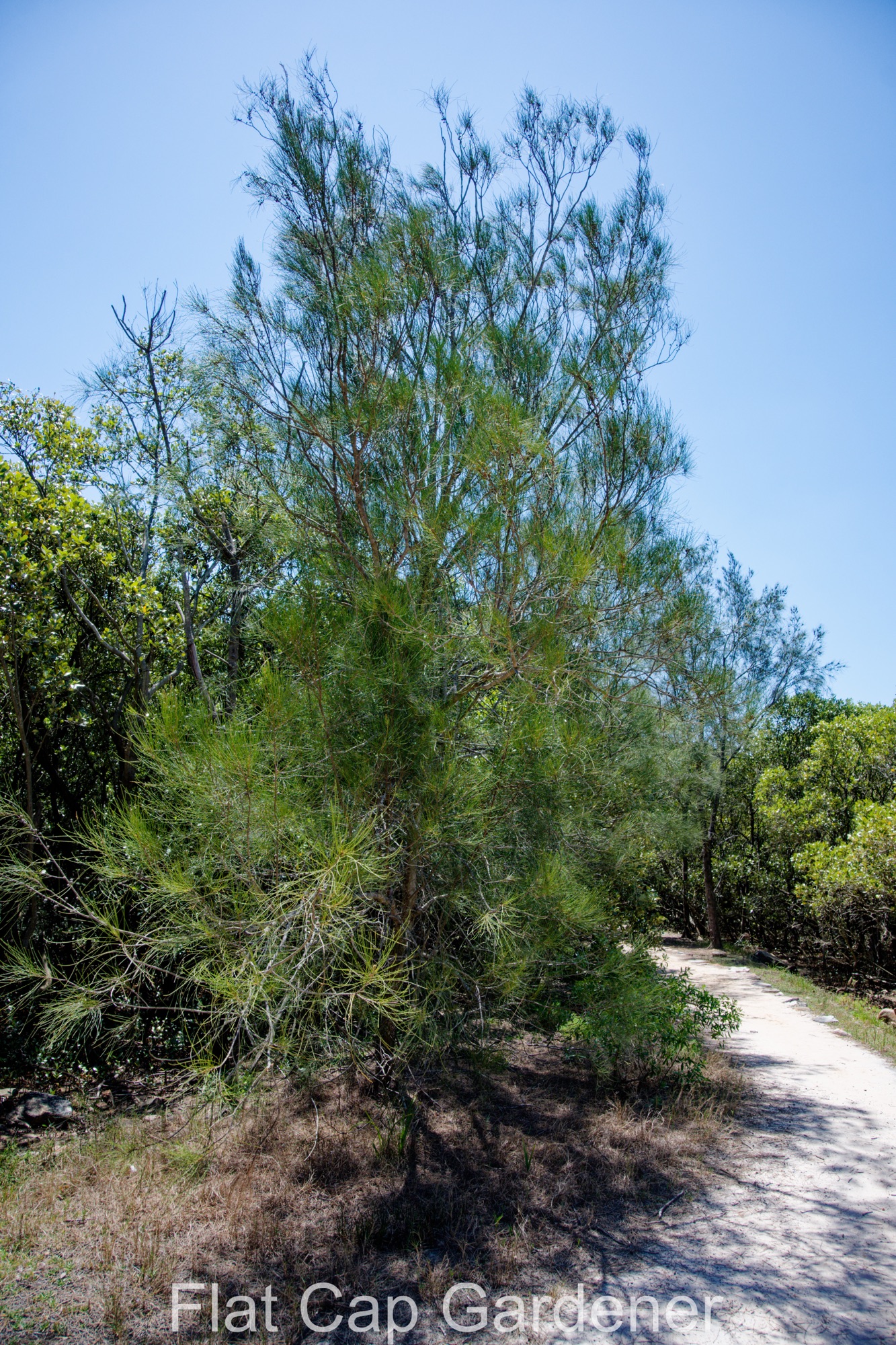
The swamp she-oak, whose binomial name is not an actual oak tree like the common name would possibly suggest, so here is a blog post about a species of tree with a slightly odd common name.
Swamp she-oaks are native to the east coast of Australia, from Eden in southern New South Wales to Yeppoon in Queensland. It usually reaches a height of up to twenty metres, but can potentially reach up to thirty-five. In coastal conditions, is more of a shrub that reaches two metres in height.
Naturally, the swamp she-oak grows in, and close to, brackish water found along the banks of rivers and estuaries. In such situations, the soil is alluvial and originates from either shale or sandstone. The water table is very high in these environments, where it is thirty centimetres below the soil’s surface at the most. Naturally, this tree turns shallow water into land over time through the prevention of erosion and through the natural accumulation of material around its roots.
The common name of the swamp she-oak, coms from the fact that it is a native of swampy soil, close to mangroves, along with the fact that the wood is apparently of similar density to that of oak trees in the genus Quercus. The binomial name, Casuarina glauca, has the following meaning:
- Casuarina–comes from the Malay word kasuari because of a perceived similarity between the drooping foliage and the feathers of the cassowary bird.
- Glauca-means blue-grey, referring to the foliage colour.
What does the swamp she-oak look like?
When mature, the swamp she-oak is a straggly looking tree that often has misshapen branches. Suckers grow from the roots of the original tree, resulting in stands (often dense) of the this one species of tree.
The leaves are tiny scales on the drooping branchlets.

Male flowers are arranged whorls on spikes that are 12-40mm long. The female cones are on a peduncle (flower stalk) that is up to 12mm long and is covered in soft rust coloured hairs when young. When mature, the cones are 15 mm long and contains samaras that are up to 5mm long.

Other interesting information
The swamp she-oak is an actinorhizal plant-it has root nodules that are nitrogen fixing, being populated by Frankia bacteria. These root nodules also produce haemoglobin. Interesting because she-oaks are not legumes and I didn’t realise plants outside the pea family had this nitrogen fixing ability.
The orchid species Dendrobium teretifolium grows on this she-oak, although I haven’t seen this before. I will keep an eye out for this orchid in my future travels.
Being an Australian species, I wasn’t surprised to learn that after fire, this she-oak regenerates from the roots.
Don’t, whatever you do, plant this tree in your garden or anywhere near underground sewer or water pipes-its roots will invade these pipes, which is never a good thing!
My thoughts on this tree
In a bushland setting, I do like this tree and other species of she-oak. They do add something to the naturally scruffy bushland of Australia.
In my work as a horticulturalist, it is an absolute pest to maintain in any sort of ‘garden’ setting, whether that’s a city park or someone’s private garden. This is because its fantastic ability to sucker from its roots anywhere it fancies.
The moral of this is leave it alone in the bushland in which you find it and plant something else in your garden!
Robinson, L., 2003, third edition, Field Guide to the Native Plants of Sydney, Simon & Schuster, Sydney
https://www.inaturalist.org/taxa/160234-Casuarina-glauca
https://plantnet.rbgsyd.nsw.gov.au/cgi-bin/NSWfl.pl?page=nswfl&lvl=sp&name=Casuarina~glauca
2 responses to “Swamp she-oak, Casuarina glauca”
[…] by this she-oak on my walk. It’s the first time that I have ever seen the female flowers of this swamp she-oak, or any other she-oak flowers for that matter. They are very pretty though, I’m glad I spotted […]
[…] there is Casuarina swamp forest (with the main tree species, the swamp she-oak, being written about Here) that is between five and ten metres above sea level (rather than the 0-2m above sea level of the […]