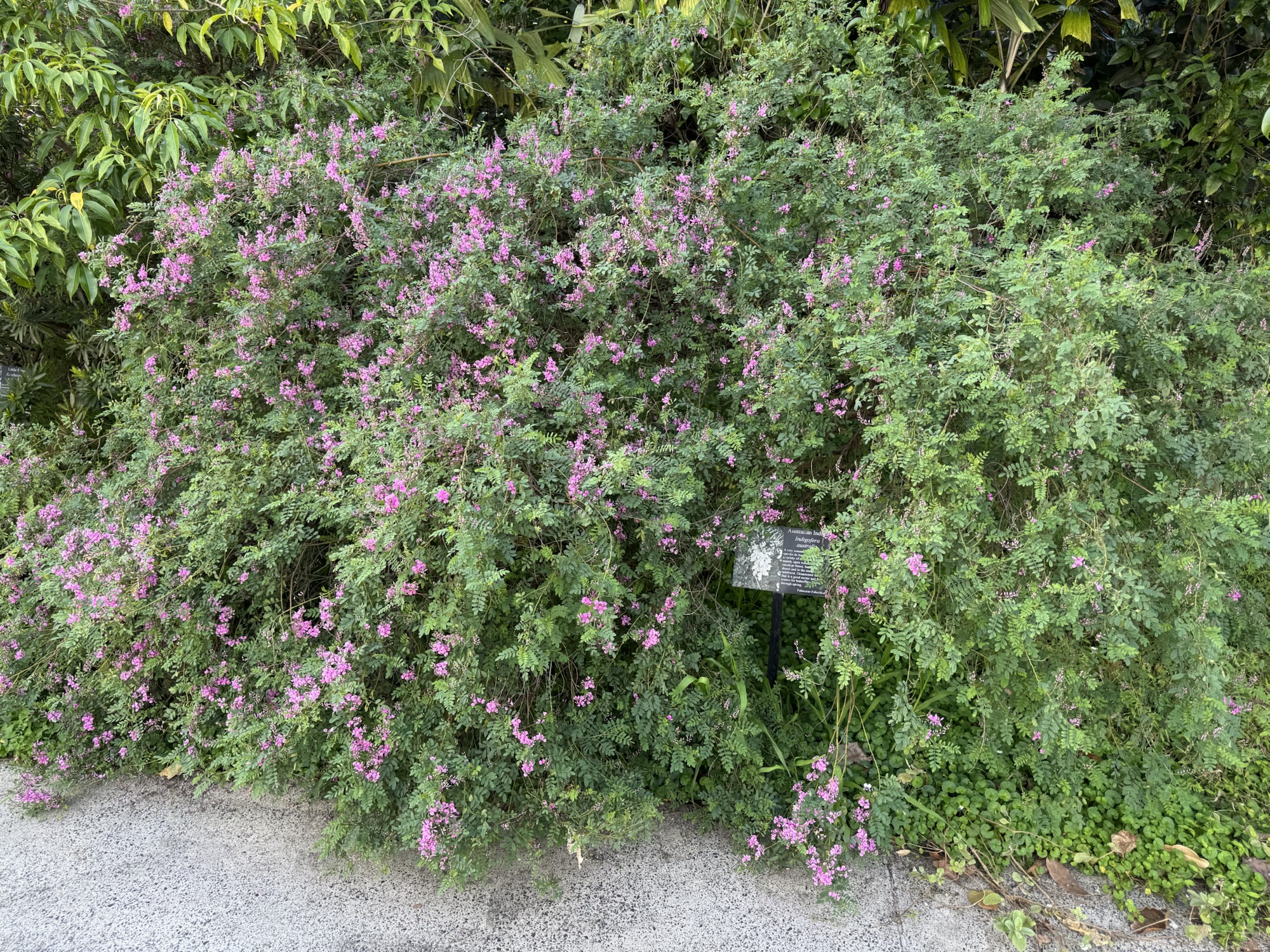
Australian indigo, or Indigofera australis, is a small, slender shrub found across Australia, apart from the Northern Territory. While this species does grow in a range of habitats, it can mainly be found in eucalyptus woodland, open forest and sometimes, according to some sources I’ve read, in desert and along rainforest margins. It is a valuable source of nectar and food for butterflies when it flowers in spring. As always, here is the meaning for the name Indigofera australis:
- Indigofera–a Latin word used to tell us that the leaves of some species within this genus give us the dye indigo, including this species.
- Australis-another Latin word that means ‘of southern lands’.
As Australian indigo has a huge range across most of Australia, the plant can vary in its size, habit and the colour of its flowers. In the wild, it can be rather straggly in appearance, while it’s less so if grown and cared for in a garden situation. This shrub can reach up to two metres tall with stems that have a habit of leaning in one direction-in some soils, Australian indigo can have an almost prostrate growth habit if plants are blown around in strong winds or storms. Clay and shale soils are its ideal soil type.
The leaves of Australian indigo are pinnate, with up to 25 elliptically shaped leaflets. They are a dull blue-green in colour and soft to the touch.

The flowers are various hues of purple and can also be a more pinkish in colour. The inflorescences are racemes appear from the leaf axils, reaching between nine and fifteen centimetres long. Most of the petals can fall off when the flowers open up, with the standard being the only petal that wont fall off at this time. In a pea-shaped flowers that this species has as a member of the Fabaceae family, the standard petal is the upper, largest petal of the flower. Spring is the time of year when Australian indigo flowers.

The flowers are followed by pods are shiny and green. Once ripe, the pods contain seeds that are hard and almost square. Plenty of seed is produced-if you want to use this seed, it needs soaking overnight in hot water before they get sown.
For me, this is a lovely native plant that should be more common in gardens than it is. I am always in favour of growing more natives in gardens (but there is always space for ‘exotic’ species too), with Australian indigo being a pretty addition.
- https://www.anbg.gov.au/gnp/gnpl/indigofera-australis.html
- Https://plantnet.rbgsyd.nsw.gov.au
- Fairley, A., & Moore P., 2010, 3rd Edition, Native Plants of the Sydney Region, Allan & Unwin, Crows Nest
- Robinson, L., 2003, 3rd Edition, Field Guide to the Native Plants of Sydney, 2003, 3rd Edition, Simon & Schuster (Australia) Pty Ltd, Cammeray