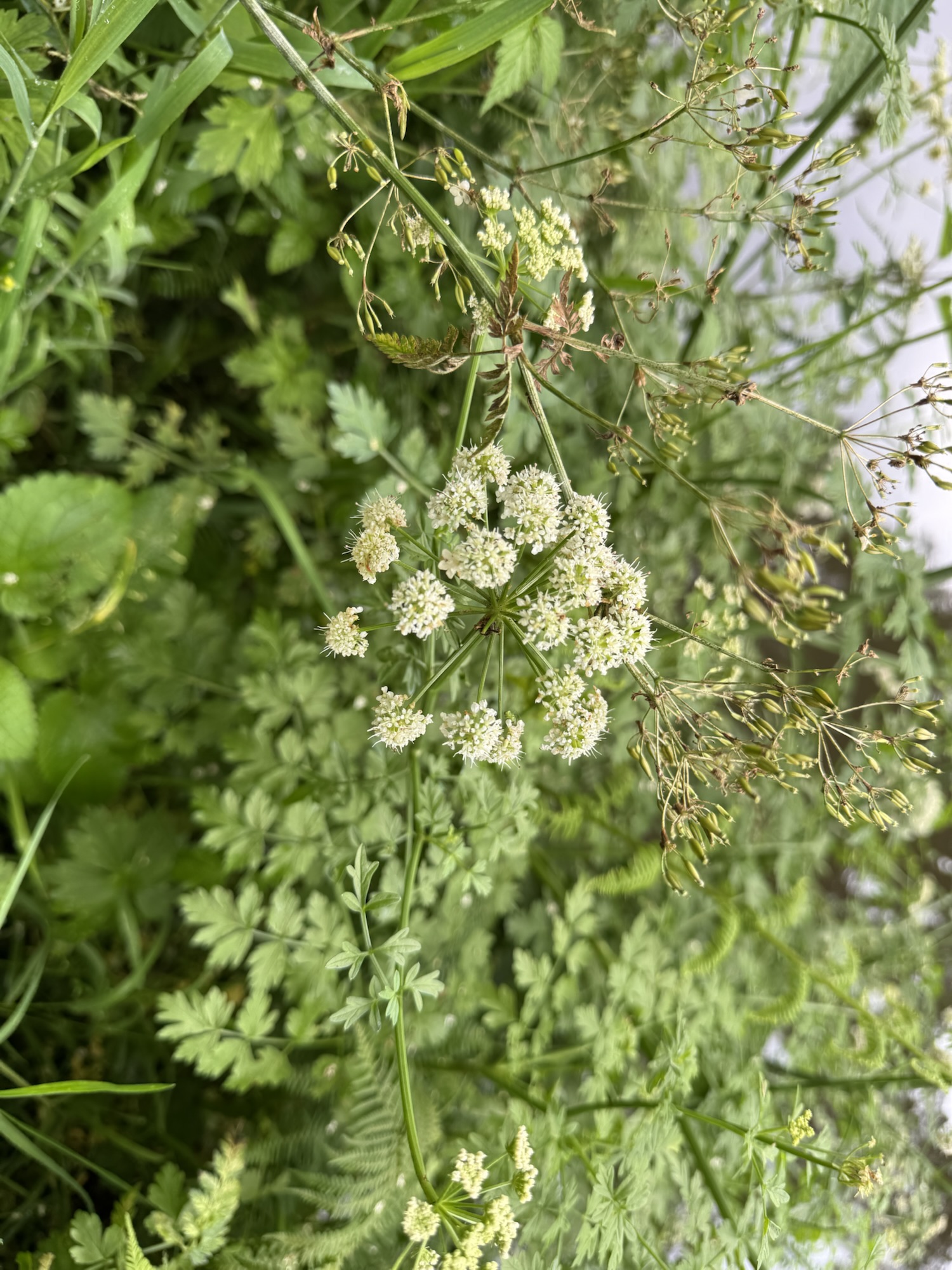
Hemlock water dropwort is a plant that reminds me of childhood in that I saw it frequently when I was roaming through the countryside when I was a kid. On a recent trip back to the UK, I took a walk along the local canal and saw plenty of this plant. As this walk was such a trip down memory lane, I thought I would talk about some of the plants I saw, this plant be one of them.

As well as being a native plant of the UK, hemlock water-dropwort is native to Europe and North Africa. This clump-forming perennial is also the most poisonous plant in the UK, so if you do come across it, don’t touch it. Hemlock water-dropwort is in the Apiaceae family, just like carrots and parsnips. Naturally, it’s found in damp areas, including meadows, near ponds, ditches and canals. The binomial name, Oenanthe crocata has the following meanings:
- Oenanthe-comes from two Greek words, oinos which means wine and anthe meaning flower
- Crocata-means ‘saffron yellow’, which refers to the oil that comes out of ducts the plant tubers
The leaves are pinnate up to four times, the whole leaf being triangular in shape. The leaflet margins are serrated (look like a saw around the leaf edges). The flowers are arranged in umbels to 10cm across and are white in colour. They appear in summer, with June and July being the main flowering months. Hemlock water-dropwort has tubers underground and hollow stems.

The conditions that hemlock water-dropwort prefers are full sun in a sheltered position. Clay or loam soil that is poorly drained is ideal. In these ideal conditions, the plant can reach up to 1.5 metres tall and 2.5 metres wide.
As all parts of hemlock water dropwort is poisonous, don’t touch it with bare hands. If it needs to be removed from your garden, use gloves and dispose of wisely.
https://www.wildfooduk.com/wild-plants/hmlock-water-dropwort/
https://www.rhs.org.uk/plants11723/oenanthe-crocata/details
https://www.inaturalist.org/taxa/82616-oenanthe-crocata