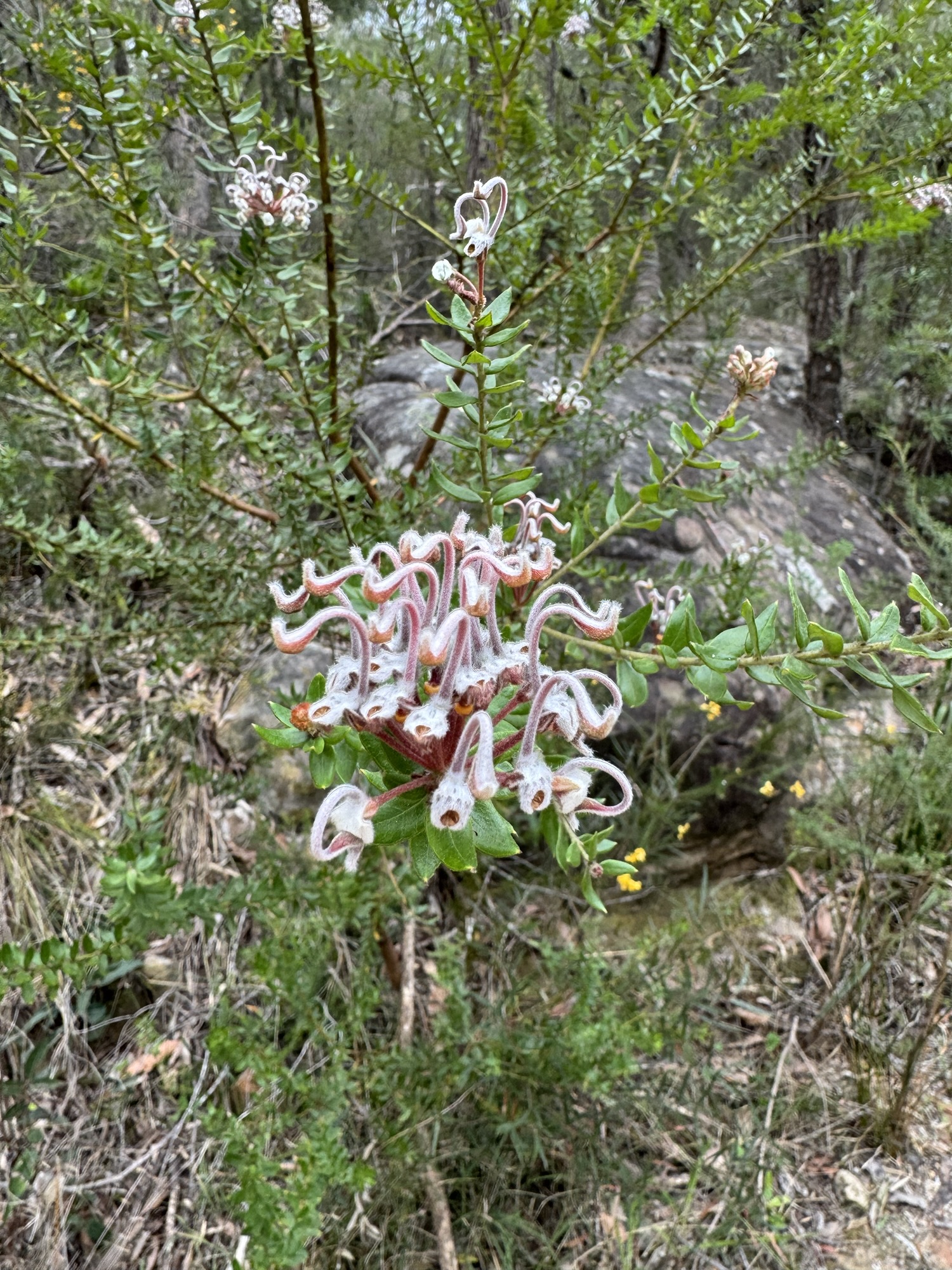
Grey spider flower, or Grevillea buxifolia, is a plant I came across when going for a walk through Lane Cove National Park about two weeks ago. As with all grevilleas, this one is in the Proteaceae family. This is the first time I’ve seen this grevillea knowingly, only noticing it because of the flowers, which are lovely-as grevillea flowers are one of my favourites types of flowers, I had to find out more!

The grey spider flower is a shrub that can reach up to two metres tall. Its natural habitat is heathland and open forests that occurs along the coast and the nearby plateaus. It is mainly restricted to the sandstone areas in the Sydney area. The meaning of the binomial name, Grevillea buxifolia is as follows:
- Grevillea-named after a man Charles Francis Greville who was an English aristocrat who collected and propagated the plants of New South Wales in the early nineteenth century.
- Buxifolia-a Latin word for box-leaved, after English box (Buxus sempervirens) whose leaves are very similar to this grevillea’s leaves.
The leaves are crowded around the stem and oval in shape. They are 25mm long by 8mm wide and shiny on the upper surface. The flowers are terminal and umbel-like. They can reach 4cm across. They are hairy and grey in colour. The flowers appear from August to November, which is from late winter to spring.

This particular grevillea is apparently well known in cultivation, but I haven’t seen it in gardens I have worked in. It is reliable in well-drained soil and semi-shade and sunny spots. As with many Australian natives, it is able to withstand long periods of drought once established and can also tolerate moderate frost.
Grey spider flower can be propagated from seed, although its likely that you will need to nick the seed coat to expose the embryo (the seed coats are hard, so that they are protected until conditions are right for germination). Cuttings can be taken from current seasons takings-conditions need to be relatively dry as the stems are hairy which can trap the water droplets.
I would love to have one of these grevilleas in my garden, but as I haven’t got the space, I’ll happily go for a walk down to the national park to take a look at this one any time get chance!
https://anpsa.org.au/plant_profiles/grevillea-buxifolia
Native Plants of the Sydney Region, Allan Fairley and Phillip Moore
Field Guide to the NAtive Plamts of the Sydney Region, Les Robinson