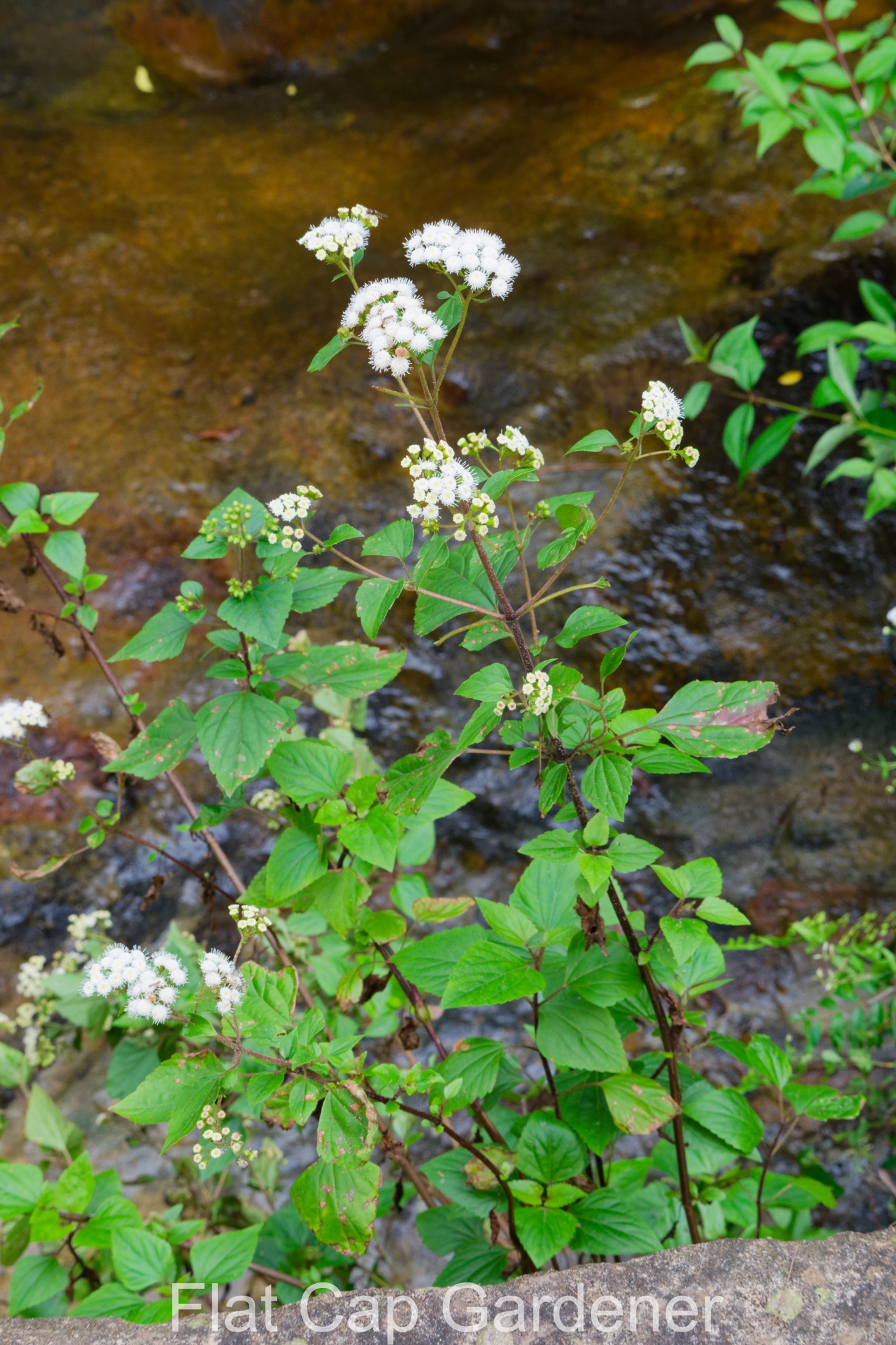
Crofton weed is a plant that does really well here in Sydney, as well as other areas of the eastern coast of Australia. It’s a multi-branched shrub native to Central America. The reason I am writing about this particular species today is because it’s a problematic weed here in New South Wales. There are several reasons for this, which will be mentioned in due course. But first, I’ll go through what it looks like.

The leaves of crofton weed are diamond-shaped. There are prominent veins on the leaves, which also have an irregularly toothed margin. In size, the leaves are between 4-12 centimetres long by 3-9 centimetres wide.

The flowers of crofton weed are really quite pretty. The flowers appear at the end of stems in dense clusters of flowers. Each individual flower is 5-8 centimetres across. As already mentioned, it is a spring-flowering shrub.

When found in the landscape, crofton weed forms dense colonies of plants. It is a quickly spreading plant that can be found along road, rail and fence corridor. It can also be found in pastures, cropland, wasteland and bushland areas. Within New South Wales, can be found as far south as Wollongong, becoming more common the further north you go.
Environmental conditions preferred by crofton weed are in coastal zones. It likes plenty of rain, at least 1500 millimetres per year, where there is little chance of frost. Soil needs to be well-drained. It can often be found on steep slopes, which is often where I see it growing. Crofton weed is mostly found in areas where the ground has been disturbed or bare-its a rare thing to find it in a well-vegetated area.
One of the reasons why crofton weed is so successful is because adult plants can produce between 10 and 100 thousand seeds per year, which is a crazily high number. Of course, not all of these will germinate, but the more seeds there are, the more chances of germination. These seeds can spread by wind, water, and by getting stuck on boots, clothing or animals.
As with many plants now classed as weeds here in Australia, crofton weed was introduced as an ornamental plant. In this case, it was before 1900, after which it had become naturalised. By the 1950’s, crofton weed had started spreading rapidly, to the point that many banana and dairy farmers abandoned their farms due to the infestations of this plant on their farms.
The question that should now be answered is why is crofton weed a weed? One reason is its ability to spread quickly in the landscape. Another one is that it is poisonous to livestock, especially horses-if they eat crofton weed, it can kill them. For farmers it reduces their crop yields and out-competes pasture grasses. In native habitats, it out-competes native plants, thus reducing habitat and food for native animal species. All of these reasons make this plant a problem.
Removing such weeds does take a lot of time and resources to make any impact on reducing the area it covers. There are mechanical and chemical methods of removal, but there is often an attitude that ‘there is too much of it so we can’t do anything’, which drives me beyond insane! Even getting into a patch of crofton weed once a month for a couple of hours a month is better than nothing! Whatever method is used to remove such weeds, consistency of effort is required-if only an hour a month in an area is possible, over time that will have an impact, especially if planting of other plants happens at the same time. Being proactive is key.
Crofton weed is a garden escape that can be poisonous to horses and causes issues in farms, disturbed areas and bushland. Removal needs the resources required to consistently work to remove it and replace it with more appropriate vegetation.