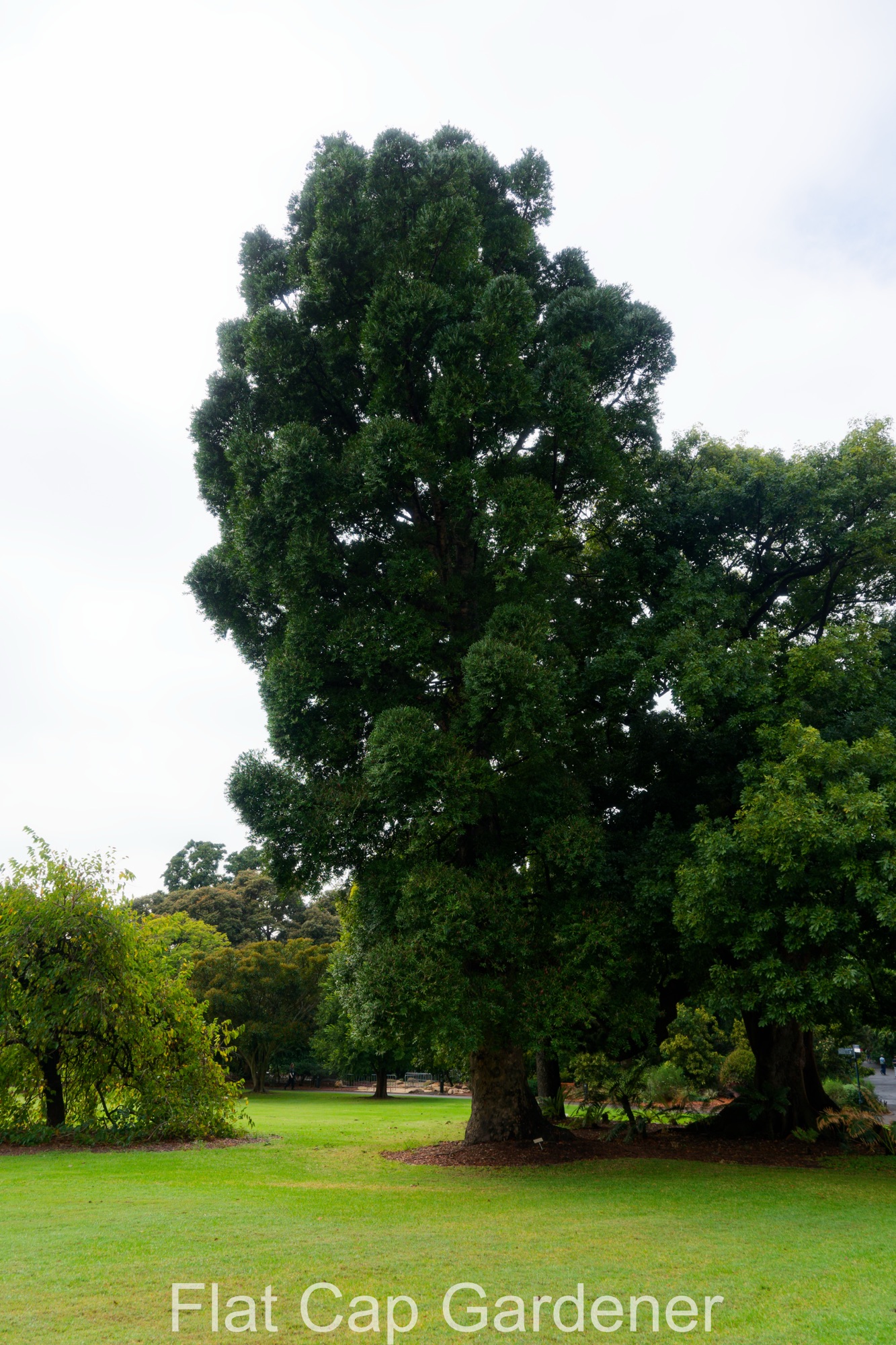
Moore’s kauri, or Agathis moorei, is a tree species hailing from New Caledonia’s main island, where it is native to sub-tropical rainforests between 250 metres and 1000 metres above sea level. While it was once widespread, its spread on Grande Terre has now been reduced due to logging and land use changes.

As a member of the Araucariaceae family, the Moore’s kauri is an evergreen tree that can reach up to forty metres tall. When younger, the crown is more rounded or conical shape. When it reaches maturity, the crown is more irregular and open. The bark can either be smooth or rough. There are scales on the bark that peel in irregular flakes that is grey when mature.

As always, here is the meaning of the binomial name:
- Agathis-from the Greek word ‘agathis’, which means ‘ball of thread‘, which refers to the cones.
- Moorei-named in honour of the 19th century botanist Charles Moore. He was the first to ‘discover’ and collect this species in1850. Charles Moore was also a director of Sydney’s botanic gardens.
The leaves are broad, flat and leathery. They are arranged opposite each other on the stems. In shape, the leaves are ovate to elliptic and 4.5 cm by 1.2 cm in size.

As with all conifers, Moore’s kauri has cones instead of flowers. The Maile cones that produce pollen are cylindrical in shape. The single cone appears from leaf axils. They can reach one centimetre in size. At the base of these cones, there are between four and eight pairs of overlapping bracts.
The female cones are also solitary, being globose in shape. They are up to 15 cm by 12 cm in size. They are green in colour then turn to brown once mature. The seeds produced on this cone have two wings on them, both of which are different sizes. They are up to 20 mm in size. The cones are wind pollinated.
Given that the tree resides in rainforest in its native habitat, the trees do grow better in shade. What makes life easier if growing this tree in your garden (admittedly, it would have to be a big garden), is the fact that the tree does need more light as it grows taller.

As with all Agathis species, the Moores kauri produces a resin that is often used in boat waterproofing, medicines, as campfire or torch fuel and as a varnish, lacquers and linoleum. While not the most prolific producer of this resin in the genus, it does produce usable quantities of it. When burnt, the smoke produced can be used as a black dye and in tattooing. The timber can be used for furniture, panelling, cabinet work and boxes and light carpentry work.
To grow this tree from seed seems relatively easy, from what I have read. It appears that the seed doesn’t stay viable beyond two months of age in ‘normal conditions’ (although doesn’t specify what these are), so needs to be sown straight away. No pre-treatment is needed and seeds aren’t viable if dried out. To sow the seeds of this species, ensure the wings of the seed are pointing upward-two thirds of the seed should be buried within the soil. Germination should occur within six days. There is a germination rate of 90-100% within ten days. Cuttings taken from the leading shoots can also be used.
There is always the question of whether I would have any species I talk about planted in my garden. For this tree, I would provided my garden was big enough. It is a rather big tree!
https://bie.ala.org.au/species/NZOR-6-9577
https://www.rhs.org.uk/plants/144222/agathis-moorei/details
https://threatenedconifers.rbge.org.uk/conifers/agathis-moorei
https://tropical.theferns.info/viewtropical.php?id=Agathis+moorei