When I was at Sydney Park, I spent a long time watching several birds doing their thing in the wetlands. I enjoyed spending about half an hour just watching the birds and loved the fact that all these birds were living in an inner city park and shows how horticulture and wildlife can (and should) exist together. I wanted to learn a little more about the birds I saw and want to share that with you.
Pacific black duck, Anas superciliosa
Who doesn’t love seeing ducks? The Pacific black duck is common, making itself known by its loud quacks. It has yellow and black stripes on its head, with a green speculum (secondary flight feathers) that’s bordered by black. You can find these ducks in many wetland areas, including sheltered seas, puddles, wet pasture and large lakes and urban wetlands across Australia. They surface dabble, filter and up-end to feed.

Australian white ibis, Threskornis molucca
The white ibis is a bird that is often derided in Sydney, as they can spend a fair amount of time in and around bins-so much so that they are often called ‘bin chickens’. I do like this species, despite the fact that they can make a mess (an there is the argument to empty bins before they are full and to have bins these birds can’t get into, but what do I know, I just look after plants for a living!). Anyway, their black hairless necks and mostly white feathers with black ones at their rear are a common sight. Apart from hanging around their favourite bin, they are seen in shallow wetlands, both fresh and sea water, swamps, lakes pasture that’s flooded tidal mud flats and even in sewage ponds. Naturally, they have a diet of carrion, vertebrates and invertebrates. As already inferred, they will also scavenge in cities.

Black swan, Cygnus atratus
This lovely black swan was my favourite bird on my visit. While it is all black, they have some white primary feathers. Their bill is red-orange. Usually found in pairs or family groups, they are common in shallow wetlands across Australia, as ponds flooded pasture, and sheltered areas of marine or estuarine waters. The black swan mostly eats algae, as well as sea grasses found under water.

Eurasian coot, Fulica atra
The Eurasian coot is a relatively small black bird with a grey bill. It can be found in lakes, rivers, urban wetlands and in brackish estuaries. Aquatic vegetation is the main diet of this lovely bird.

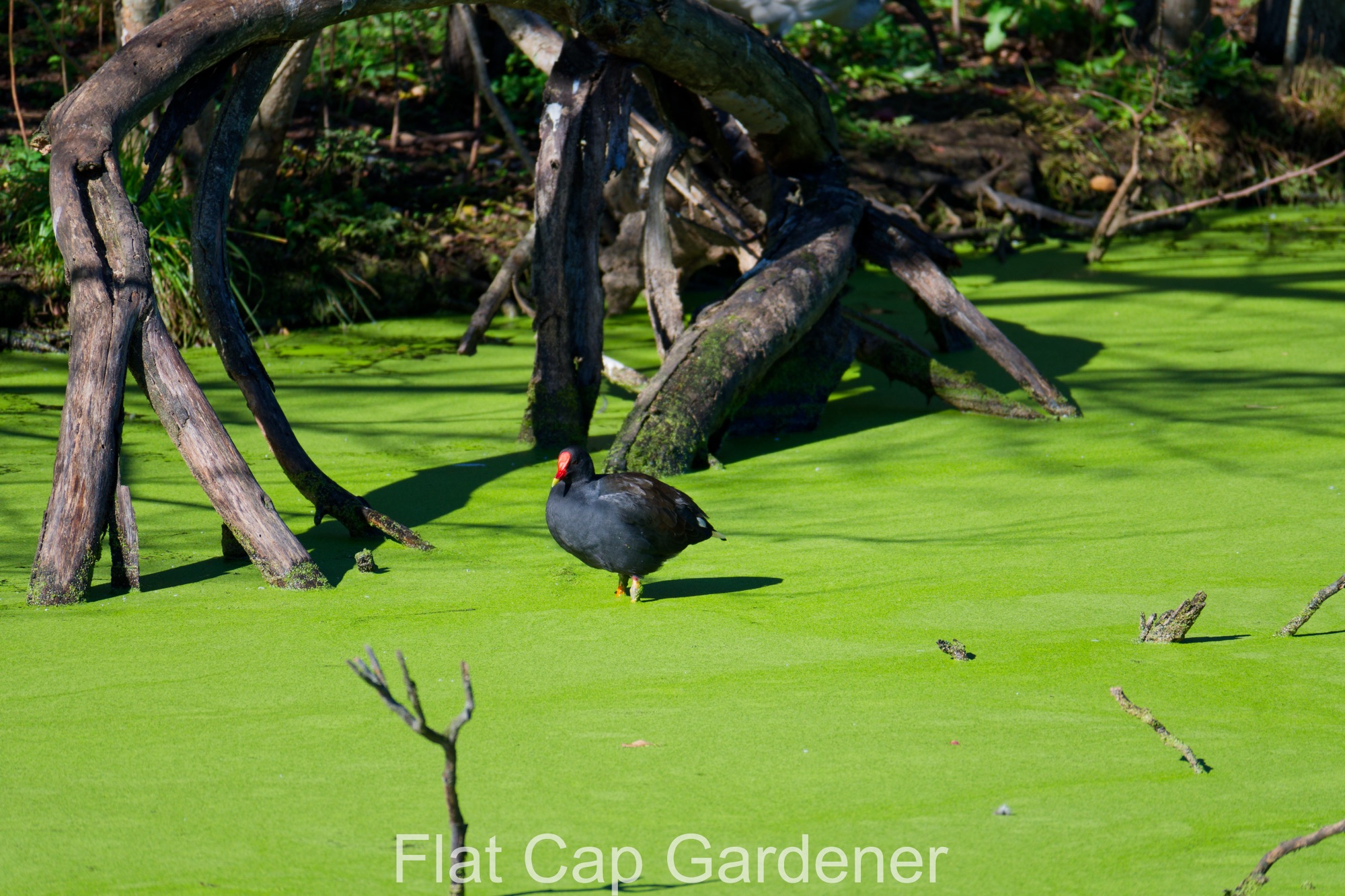
Dusky moorhen, Gallinula tenebrosa
The dusky moorhen is a black water hen that has white sides on its undertail. It’s a native of the states of New South Wales, Victoria and ACT, along with parts of Tasmania, South Australia and the Northern Territory. Dusky moorhens like areas of dense cover, especially reed beds around rivers, swamps, freshwater lakes and, of course urban wetlands. They forage through the surface vegetation and through grass as well.

Purple swamp hen, Porphyrio melanotus
The purple moorhen is a bird with blue-purple and black feathers and a bill that’s red and ‘pre-historic’ looking. As well as urban wetland, like those in Sydney Park, purple swamp hens are often seen around lakes, rivers, swamps and in estuarine habitats. They forage in and around water-they eat a range of plant material, especially reed bases and the stems of rushes. The purple swamp hen is commonly found in the east, south-east and south-west of Australia.

These are six lovely Australian birds that I enjoy watching, although there are many more of those! I will include more about birds as I go along and find the time, but, for now, I hope you have enjoyed.
Menkhorst, P., Rogers, D., Clarke, R., Davies, J., Marsack, P., Franklin, K., 2021, The Australian Bird Guide, CSIRO Publishing, Australia