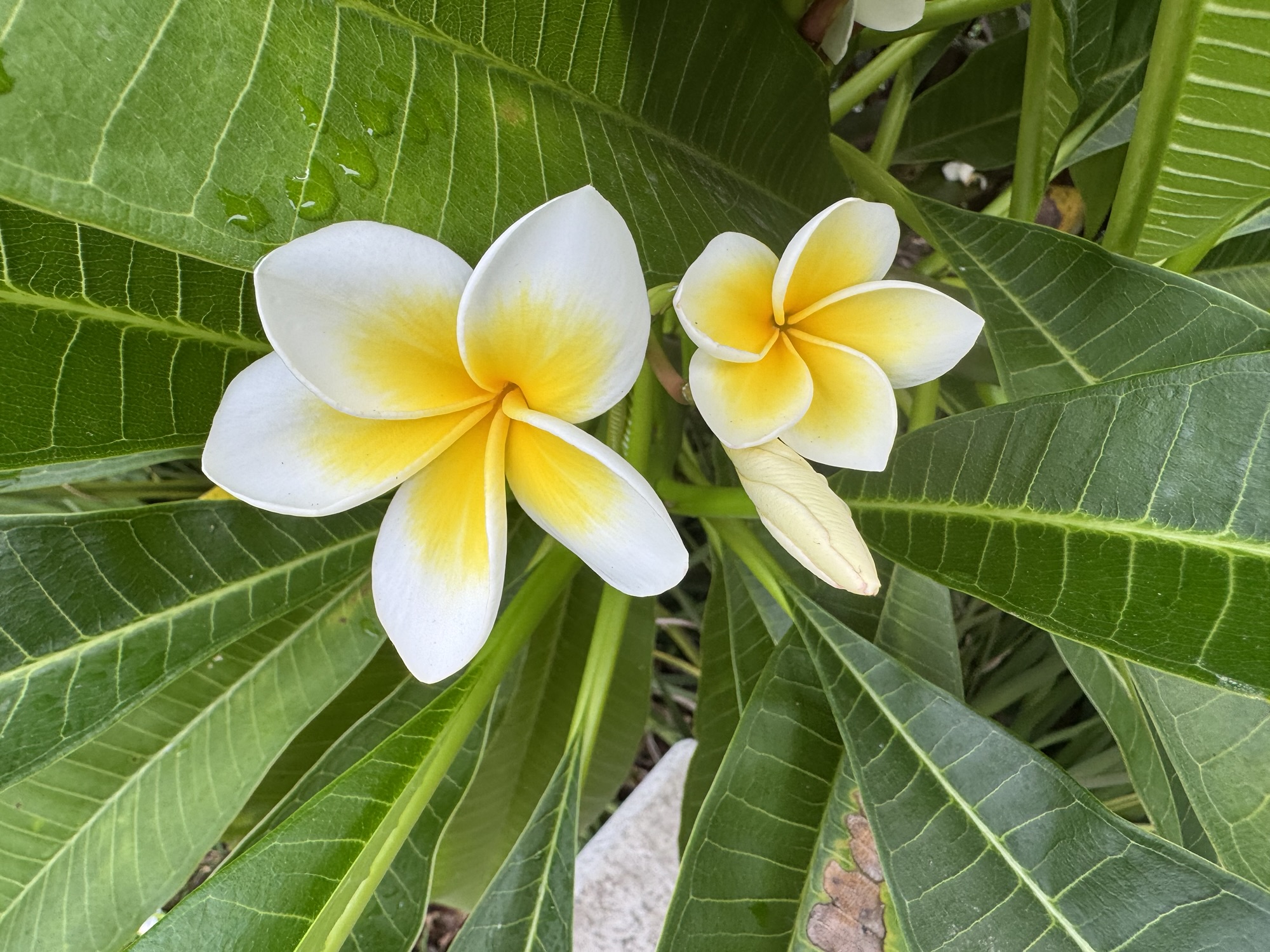
Frangipani, or Plumeria rubra, is a plant that represents holidays, summer and sunshine. The frangipani hails from Mexico, Central America, Venezuela and Colombia. I see it all the time here in Sydney gardens and when I have travelled in tropical Asian countries like Singapore, there have also been many fine examples on show, especially in Singapore’s botanic gardens. Frangipani as a name apparently comes from an Italian nobleman (from the 16th century) that created a perfume with a similar smell to the flowers of the plant that now bears his name. The binomial name, Plumeria rubra has the following meanings:
- Plumeria-the name of a French Franciscan monk Charles Plumier, who was also a botanist and traveller.
- Rubra-the Latin word for red
As it comes from countries like Mexico and Colombia, the frangipani needs to be grown in tropical and sub-tropical climates to grow well, otherwise they need to be grown indoors in bright light. USDA hardiness zones are 10-12, where the temperatures are above -1 degrees Celsius, but in reality I don’t think frangipani trees would survive temperatures that cold.
The leaves are rather large, reaching between 20-40 cm in length. They are elliptic in shape. They are arranged spirally around the branches and mostly clustered around the branch tips. This species is also deciduous, so no leaves in winter, which is a shame in my opinion.

The flowers are the reason to grow a frangipani. They can be pink, purple, yellow, red or white. They appear from spring, through summer and into winter. The flowers have five petals and appear in clusters at the end of branches. Fruits do follow the flowers, but they rarely appear when in cultivation. They are cylindrical pods, although I have never seen one.


Frangipanis do need a sheltered position in the garden that receives full sun to be happy. Soil should contain plenty of organic matter and be well-drained. It is poisonous to pets (although I never see any that are interested in eating it!).
Propagation can be done by seeds (sow in spring) or through cuttings (allow the cutting to dry at the base and insert into cutting raising mix). You will then get some nice new plants.
I love seeing a frangipani or two around in a garden setting. They are a very attractive plant that looks good and reminds me of happy trips to tropical countries.
All photos are my own.
https://www.missouribotanicalgarden.org/PlantFinder/PlantFinderDetails.aspx?kempercode=d451
https://www.mq.edu.au/__data/assets/pdf_file/0004/1339636/Plant-of-the-week-Plumeria-rubra-1.pdf
https://www.nparks.gov.sg/florafaunaweb/flora/3/0/3074
https://www.rhs.org.uk/plants/94126/plumeria-rubra/details