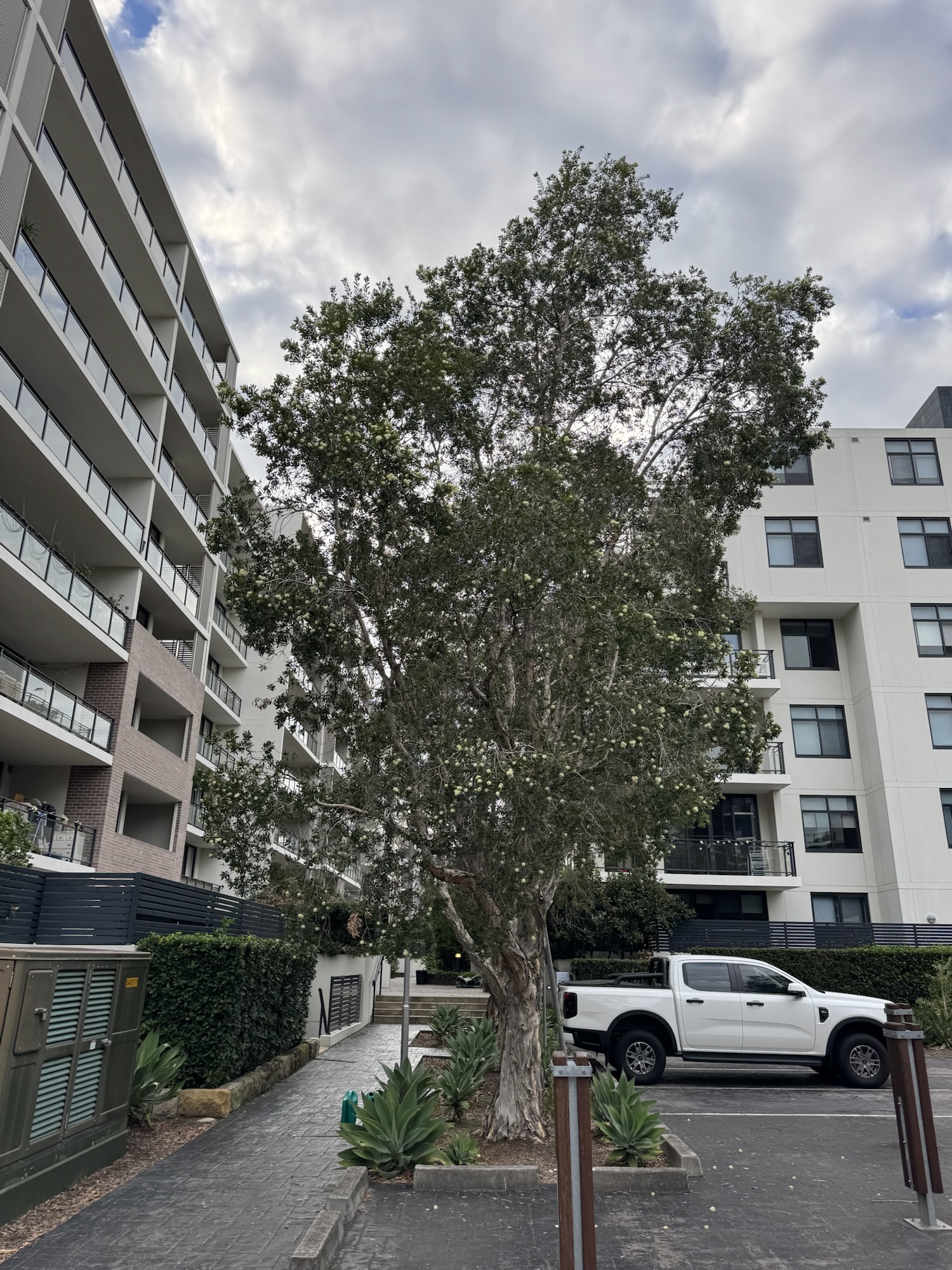
Melaleuca quinquenervia, or the broad-leaved paperbark, is a rather grand tree in my opinion, in a way only trees native to Australia can. It is a little odd in some its features at first glance, but more interesting because of this. That may be the opinion of a plant nerd, but I hope you agree too.
The broad-leaved paperbark is a native of the east coast of Australia, from Botany Bay in Sydney’s south up to Cape York in Queensland. As with many native plants within Australia, paperbarks belong in the Myrtaceae family. The tree can reach a height of 25 metres in the wild, but in cultivation it is usually around 10-15 metres tall. Its spread can reach up to ten metres wide. The common name, paperbark, comes from the fact that the bark is soft and like paper.

The binomial name, Melaleuca quinquenervia, has the following meanings:
- Melaleuca-comes from two Greek words: melas meaning black and leukos meaning white. This comes from the fact that these trees can often be found with black marks on the white bark from bush fires.
- Quinquenervia-derived from two Latin words: quinque which is the Latin word for five and nervus which means nerve. Together, these two weeds refer to the pattern of the leaf veins running through the leaf.
The leaves are flat and tough with veins running down their length. They can reach a size of 70 mm by 20 mm. They are elliptic in shape and arranged alternately along the stems. Leaves are a dull green colour.

The flowers are cream or white spikes that look like bottle brushes. The flowers appear between February and March (lat summer/early autumn) here in Australia, reaching up to 5 cm long. An interesting feature of these flowers is that they are terminal (at the end of a stem), but instead of the stem finishing its growth there, it continues to grow on the other end of the inflorescence. When I took this photo, the rainbow lorikeets and myna birds were loving feeding on the nectar found within these flowers-a definite benefit of this tree!

The flowers are followed by cylindrical fruit that is 4-5 mm in diameter.
Habitat for this paperbark is swampy or marshy ground around lakes and coastal areas.
Traditionally, the flowers were used to make a drink, and the bark was used for shelter and fire by Aboriginal people. Many species of paperbark are used for tea-tree oil, but this species isn’t used for this purpose, although it is frequently used as a street and park tree here in Sydney.
https://plantnet.rbgsyd.nsw.gov.au/cgi-bin/nswfl.pl?pag=nswfl&lvl=sp&name=melaleauca~quinquenervia
https://gardeningwithangus.com.au/melaleuca-quinquenervia
https://anpsa.org.au/plant_profiles/melaleuca-quinquenervia
Robinson, L., 3rd edition, 2003, Field Guide to the Native Plants of Sydney, Simon & Schuster, Sydney
Fairley, A.,& Moore, P., 3rd edition, 2010, Native Plants of the Sydney Region, Allan & Unwin, Sydney
2 responses to “Broad-leaved paperbark-Melaleuca quinquenervia”
[…] of my favourite trees is the broad-leaved paperbark (Melaleuca quinquenervia,more info here), in part because of the flowers. The bark is also rather […]
[…] Finally for today is the flower of the broad-leaved paperbark or Melaleuca quinquenervia (read about it https://flat-cap-gardener.com/2026/02/03/broad-leaved-paperbark-melaleuca-quinquenervia/. […]