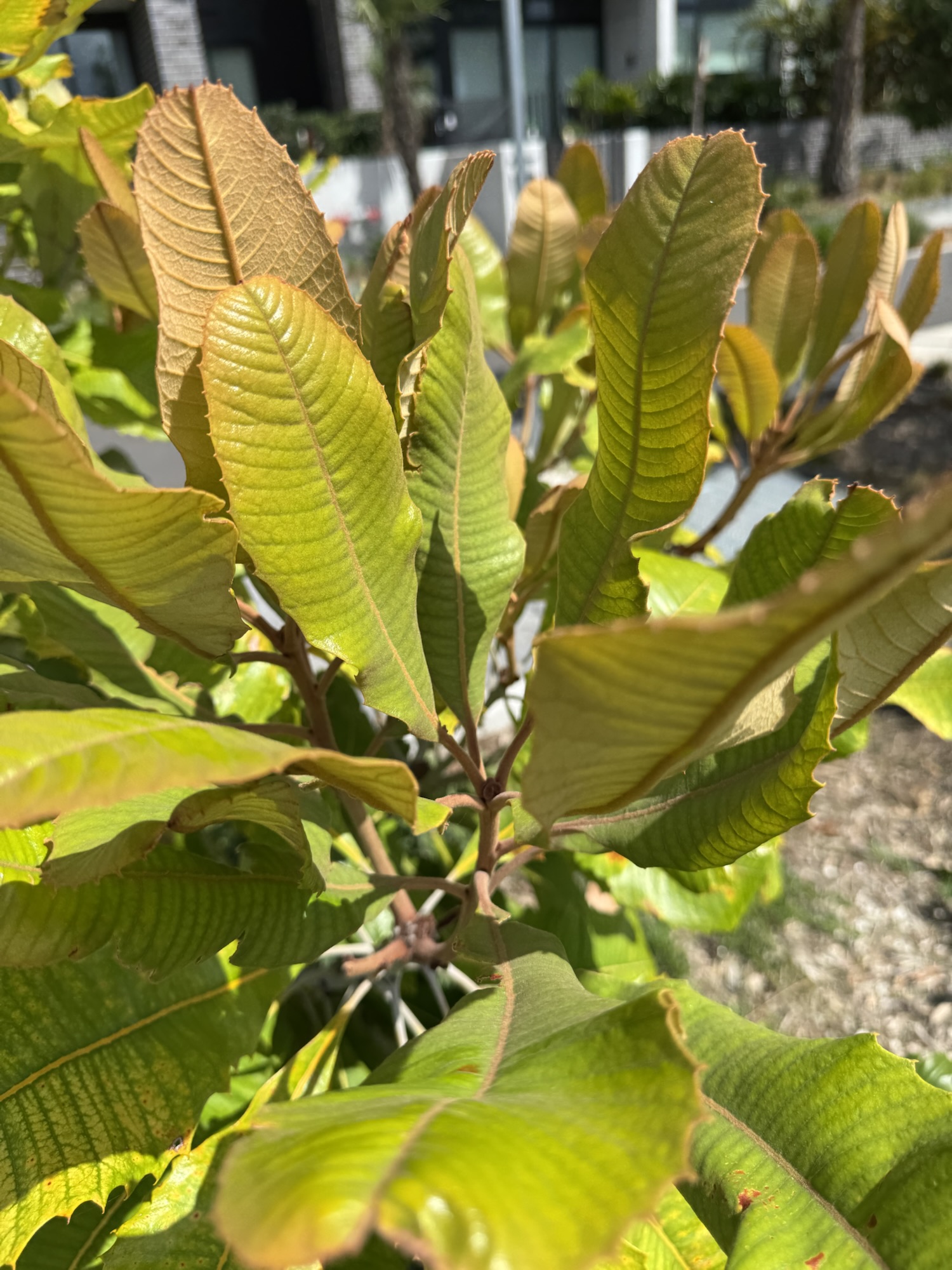
The swamp banksia, Banksia robur, is a new species for me that I spotted a few weeks ago in a fairly new street planting I walked through. As usual, I decided to know a little about this shrub.
This particular banksia can reach two metres tall by two metres wide as long as it is in full sun or partial shade. As the name suggests, it naturally occurs in areas with wet soils but is adaptable to others-the examples that I have seen aren’t in boggy soil at all and seem to be doing well. The habitat of the swamp banksia is swampy areas in The natural range of swamp banksia is from the Illawarra region to the south of Sydney to Gladstone in Queensland. The binomial name Banksia robur means the following:
- Banksia-named after Sir Joseph Banks, the British scientist that travelled to Australia with Captain James Cook.
- Robur-the Latin word for ‘strength’. Some sources say that this refers to the tough leaves while others say this moniker refers to the robustness of this species.
The leaves of the swamp banksia are large-up to 40 cm long by 12 cm wide. The edges of these leaves are serrated (they look like they have teeth). The leaves are green on the surface, while underside of the leaves are a lot paler. New growth is a lovely rusty brown colour, as you can see in the photo below.

As with most Australian native plants, the flowers are my favourite part of the species I’m talking about at the time. For the swamp banksia, the flowers, when in bud, are a blue-green colour but change to yellow-green as the flowers open up.


In the research I have done, many sources that I have read say that flowering time is autumn and winter-from March to August in Australia, with only a little flowering throughout the year. Others say from January to July, so the middle of summer to winter. From what I have seen, the swamp banksias were flowering well in November and now in December so must go crazy with the flowers in their ‘official’ flowering season.
Propagation is by seed, which germinates in three to five weeks. Seedlings need pricking out when they still only have their cotyledons (the ‘seed leaves’ that are what come up from below the surface of the soil) and grow on in well-drained potting mix until planting into its final position. Another point to note is that if using fertiliser to fertilise the swamp banksia, an Australian native fertiliser needs to be used-plants in the Proteaceae family have evolved to thrive in soils with low phosphorous, meaning they are sensitive to too much of this element, so this fertiliser caters to this fact.
Swamp banksias are mostly free from pests, except from the odd leaf chewing insects and is mostly resistant to root rot.
As with other banksias, this one attracts wildlife. Nectar eating birds, butterflies, butterflies and many other insects.
I really do like this banksia and I don’t know why I haven’t seen more of it in boggy garden areas-something that many people struggle to find plants for. If I had the space, I would definitely have one in my garden.
One response to “Swamp banksia-Banksia robur”
[…] The swamp banksia (Banksia robur) is a lovely shrub native to Australia, that I have written about Here. […]