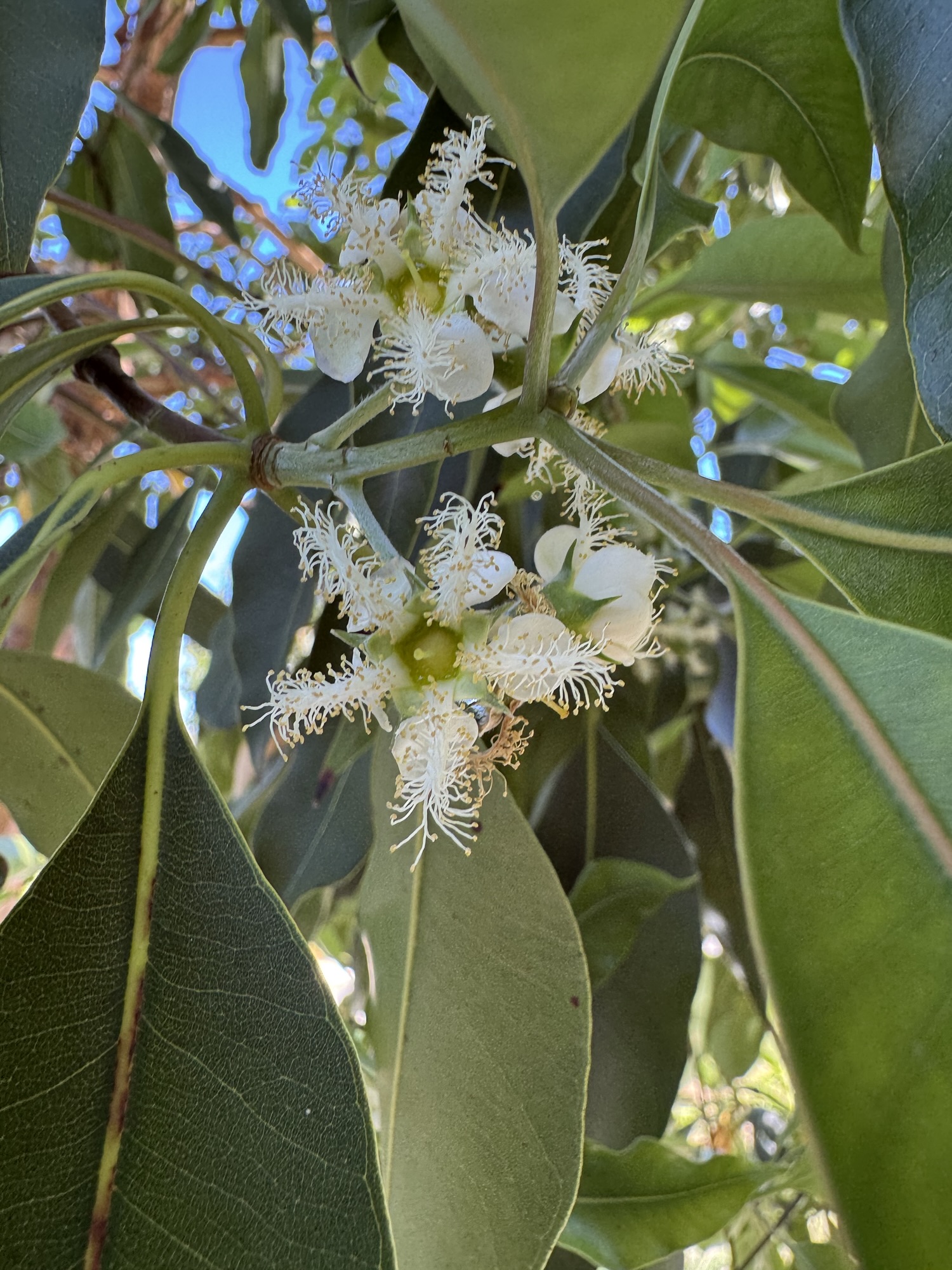
Lephostemon confertus, to the brush box, is a rather grand looking large Australian tree. it has Berk that’s rough and brown on the lower section and on the branches, the bark is pink-brown in colour and smooth. The brush box can reach up to 25 metres tall and 15 metres wide with a crown that has a rounded shape if allowed to grow in its natural form. As with many trees native to Australia, the brush box belongs in the Myrtaceae family. Now, onto the meaning of it binomial name, Lephostemon confertus:
- Lephostemon-comes from two Greek words, lofos hill or crest and stema which means staman. Together, this means ‘crested stamans, referring to the appearance of the anthers of the stamans.
- Confertus-Latin for crowded or dense, likely for the appearance of the anthers on the stamans again.

The leaves are either elliptic or ovate in shape, arranged in ‘false whorls’ of 4-5 leaves at the end of the current seasons growth. The leaves reach up to 17.5 cm long by 4.5 com wide. They are glossy green in colour.

The flowers of the brush box are really, really pretty. White in colour, they appear in inflorescences in spring and summer. The flowers are followed by hemispherical fruit that are 8-12 mm in diameter by 2-3 mm long.

Brush box grows in the Hunter Valley (north of Sydney) in New South Wales and northwards into coastal Queensland, up to 850 metres above sea level. Native habitats of the tree are wet schlerophyll forests, rainforest margins and in areas where rainforests are grading into eucalypt forest.
Tropical and sub-tropical climates are where this trees is happiest, but can cope with Mediterranean and temperate climates too-this species does very well in Sydney. The brush box is best in moist, fertile and well-drained soil, but tolerates poorer soils and will even tolerate boggy and poorly drained soils.
The brush box has been used as a street tree quite frequently in some parts of Sydney. As well being an absolutely great looking tree, there are lots of other reasons why it does well in urban areas. One advantage compared to eucalypts is that this tree rarely, if ever, drops branches (where eucalypts can do this fairly frequently). Heavy pruning, smog, drought, light frost and poor drainage are all tolerated while still looking good. It is a hardy tree once established.
This tree is also great for wildlife. Bees, nectar-eating birds and other insects all use this tree. Brush box is a food plant for the larval stages of three species of butterflies-the common red-eye, the rare red-eye and the eastern flat.
Uses include timber flooring, wharf decking, erosion control, pollution tolerance, bird nesting, streets and parks and also because it’s a fast growing species.
For me, the brush box would certainly have a home in my garden if I had the space for a large tree. Unfortunately, I live in an apartment so I can’t. On the plus side, I do see a few good brush box examples at work, or if I go to certain parts of Sydney. A very nice tree for a good sized space.
https://plantnet.rbgsyd.nsw.gov.au/cgi-bin/NSWfl.pl?page=nswfl&lvl=sp&name=Lophostemon~confertus
https://gardeningwithangus.com.au/lophostemon-confertus-queensland-brush-box/
https://apps.lucidcentral.org/rainforest/text/entities/lophostemon_confertus.htm