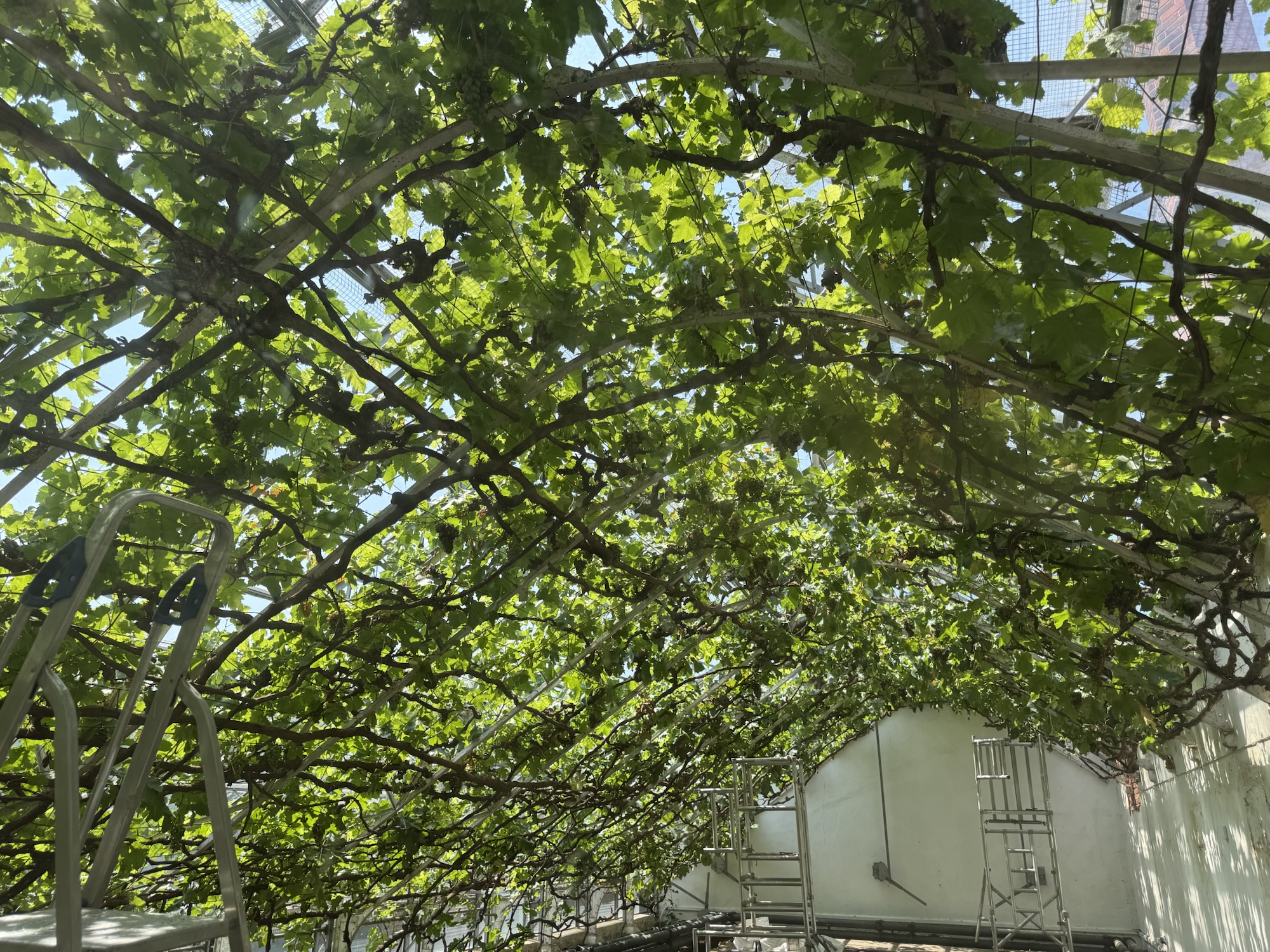
When I visited Hampton Court Palace in June, one of the most interesting plants across the gardens was The Great Vine. As a very old (257 years at the time of writing) and really large grape vine planted just for grapes for the ‘Royal Table’ I actually find it really interesting that it is still thriving and producing grapes every year.

The Great Vine was taken as a cutting from a ‘Black Hamburg’ grape from Essex in 1768 by none other than Lancelot ‘Capability’ Brown, the English landscape gardener and gardener. This once small cutting thrived from the beginning, producing more than 2,000 bunches of grapes per year by 1800. Today, the vine is still able to produce an average of 300kg of grapes a year, which can be bought from the palace shop in early September (unfortunately, I was there at the wrong time of year for the taste test).

Labelled as the largest vine in the world, with the longest rod being 36.5 metres long and the trunk being four metres in diameter when last measured, it has its own official vine keeper whose job it is to care for it. This includes the fertilising with organic matter, thinning bunches of grapes and individual grapes to allow better airflow and a better quality crop of grapes, which is then followed by harvesting.
Today, the rather impressive grape vine lives in a vine house built in the 1960’s. This is the site of the first greenhouse that was built at Hampton Court. What I like is that the vine house is built so that the roots of the vine are outside, while the vine itself is inside. The soil surface of the vine is kept bare so that there is no competition for water and nutrients with the vine.

I love a good bit of history and when that combines with plants, I enjoy this even more. I just wanted to share a bit of information about a plant that is interesting for a plant nerd because of its age and size, fitting in well with the history that surrounds it.
- All photos are my own
- The Story of the Gardens at Hampton Court Palace by Susanne Groom, 2016, Historic Royal Palaces
- Https://www.hrp.org.uk/hampton-court-palace/whats-on/the-great-vine