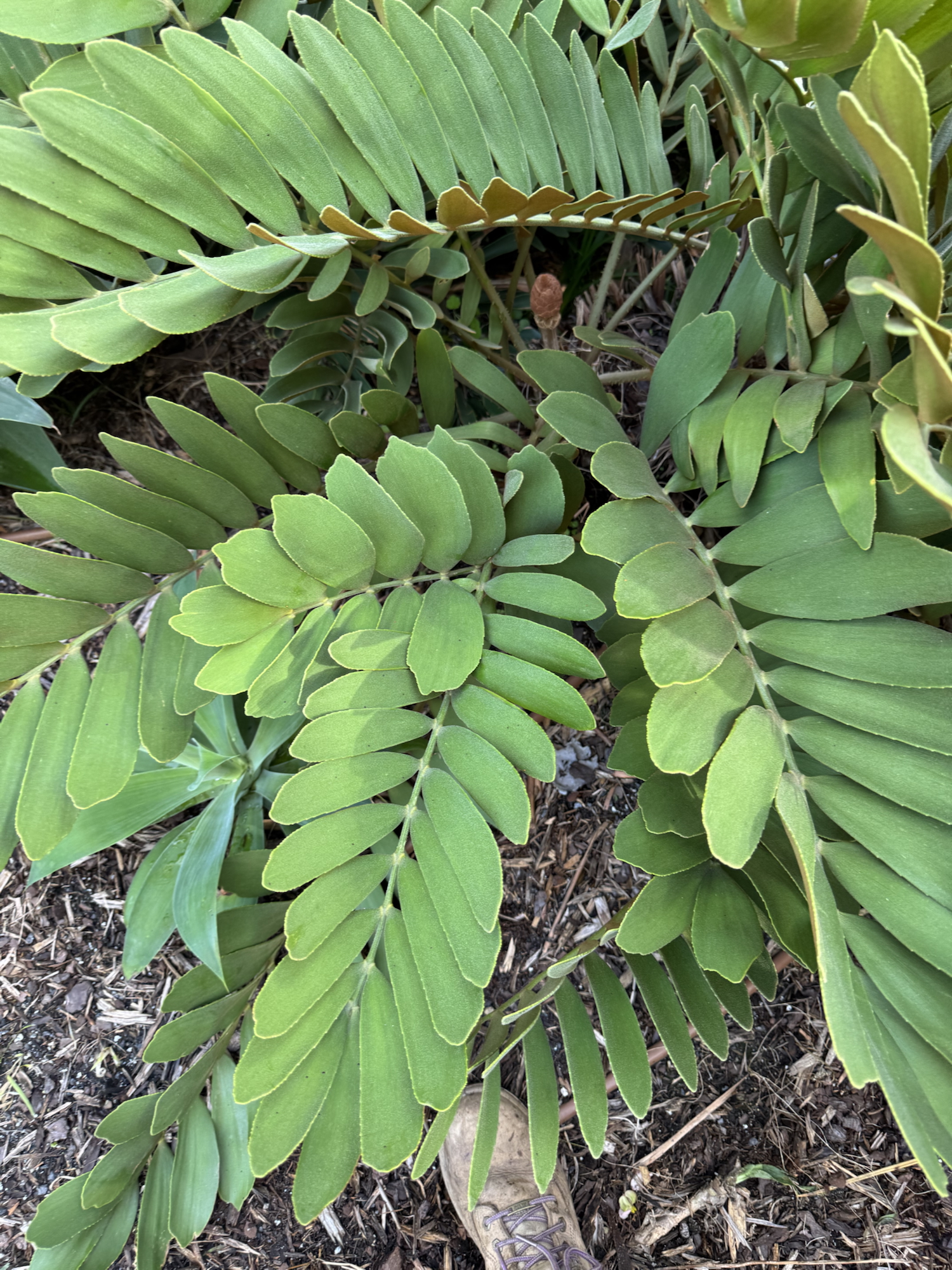
The cardboard plant, or Zamia furfuracea, is a rather interesting plant that looks good, is rather tough and is underused in a big way-especially as it doesn’t get too big. It is another slow-growing cycad, coming from the east coast of Mexico, with its native habitat being pine woodland, scrub with sandy soils and limestone sea cliffs. The binomial name, Zamia furfuracea has the following meanings:
- Zamia-Latin for pine nut
- Furfuracea-mealy or scarfy
This small cycad is has a single cylindrical trunk that can branch, but rarely. On the trunk, there are whorls of leaves that are erect to approximately 1.5 metres long. Each leaf has 24 oblong to lance-shaped leaves. These leaves are very stiff and olive green with red hairs on them. To be honest, the leaves don’t really feel like leaves-they do feel more like cardboard, which is where the plant gets its common name from.

As with other cycads, the cardboard plant is dioecious, meaning it has seperate male and female plants. Female cones are ovoid, felted and red-brown in colour, reaching 10-13cm in size. Male cones are insignificant and cylindrical in shape.
In terms of climate, the cardboard plant likes to be in sub-tropical to tropical conditions, although in cooler areas it can be planted in pots and brought indoors for the winter. Full sun to part shade are the ideal sun levels and well-drained soil is important too. Once established, it’s very drought tolerant. The height and spread is up to 1.5 metres.

The cardboard plant is great in low-maintenance and coastal gardens, as well as being great as a feature plant in a patio or courtyard garden. Ensure well-drained soil, with protection from any heavy frost in winter. If you want a mass planting, space individual plants 1.5 metres apart so that they have plenty of space to grow. Water well, but allow the soil to dry out between each watering-overwatering isn’t ideal for the cardboard plant!
Seed is the only way to propagate this plant. Germination is slow and is apparently difficult in cultivation. In the past this has lead to many specimens being taken from the wild, leading to the plant being endangered in the wild. It is now propagated copiously from seed to the point that plants are not collected from the wild, but habitat loss is still an issue.
Would I have this cycad in my garden? I absolutely would if I had the space. It is easy to look after and looks good. I just wish I had the space!