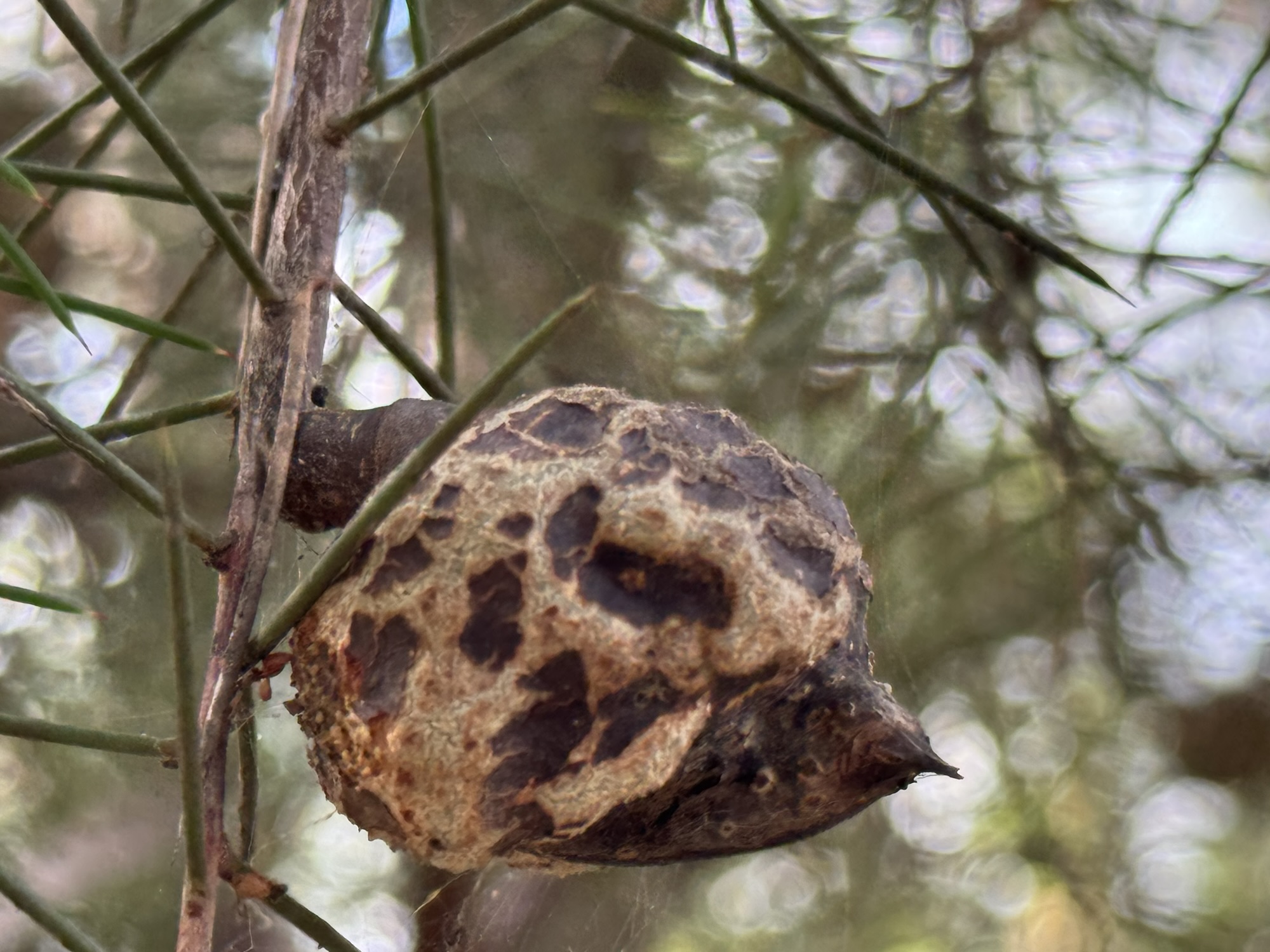
Silky hakea, or Hakea sericea, is one of those uniquely Australian plants that is under-rated as a plant in my humble opinion. A member of the Proteaceae family, this is a shrub that reaches up to three metres tall. I have only seen it growing in bushland settings, but from doing some reading, it is sometimes grown in gardens too. This is very much a shrub native to New South Wales, along the coast and mountains, with different books and websites saying that it is also growing in Queensland, Victoria and Tasmania. The common name, silky hakea, comes from the fact that new growth has tiny, silky hairs on it. The binomial name has the following meanings:
- Hakea-named after Baron von Hake, a patron of Botany during the 18th century.
- Sericea-means silky, referring to the tiny hairs on the young, mew growth.

The native habitat of this hakea is within dry schlerophyll forest, heathland and scrub. It is the most abundant hakea species in the Sydney region, especially to the south of Sydney Harbour.
- Leaves-slender (only 1mm in diameter), cylindrical and needle-like, 3-5 cm long and fine hairs on new leaves, have sharp points
- Flowers-appear in the leaf axils (where leaves join the branches) in clusters of up to seven, 3-8mm long, white (there is apparently rare pink form, but I haven’t seen one), followed by a follicle (the fruit). Flowers in winter.
- Fruit-follicle, ovoid to globose in shape, approximately 3cm long by 2cm wide, with a ‘beak’ to 4mm long. They are rather knobbly and wrinkled in appearance. The fruits stay on the tree, often for years. The fruits only open up to release the two seeds inside when the plant either dies or is burnt by fire (many Australian natives have similar reactions to fire).
- Soil-this hakea does grow in lighter sandy and in heavy clay soils, but will grow bigger in the lighter soils. It can also be very drought tolerant too-not surprisingly so for this sort of shrub.


There is a word of caution with this hakea, as it is one of those plants that is rather weedy outside of its natural range. While for some, the idea that a native plant of Australia can be considered a ‘weed’ in areas of its native country doesn’t make any sense whatsoever, it can be the case. This is because the plant in question has a habit of quickly taking over that particular area, out-competing plants native to that area. This hakea is far from the only species capable of doing this. Choose plants wisely for your garden, and switch to a similar looking plant if you think this plant could be a problem.

In Spain and Portugal, this hakea is used in land reclamation. It’s also a good species for pollinators like bees, which is also a bonus. It’s also resistant to honey fungus.
While not a very showy shrub, I do like plants like this with a bit of an untidy look to them. The fruit is a rather interestingly odd one to look at too, but I do like an oddity-they are far more interesting to look at!

References
https://www.anbg.gov.au/gnp/gnp3/hakea-sericea.html. Accessed 18/04/25
https://plantnet.rbgsyd.nsw.gov.au/cgi-bin/NSWfl.pl?page=nswfl&lvl=sp&name=Hakea~sericea. Accessed 18/04/25
https://temperate.theferns.info/plant/Hakea+sericea. Accessed 18/04/25
Fairly, A and Moore, P., (2010), third edition, Native Plants of the Sydney Region, Crows Nest, Allan & Unwin
Robinson, L., (2003), third edition, Field Guide to the Native Plants of Sydney, Cammerray, Simon & Schuster (Australia) Pty Ltd
All photos are my own
One response to “Silky Hakea-Hakea sericea”
[…] This rather quirky looking seed pod is from the silky hakea, or Hakea services. It is a member of the Proteaceae family that’s native to Eastern Australia. When it is in flower, it has a mass of pretty white flowers. I have written about this lovely plant before, here. […]