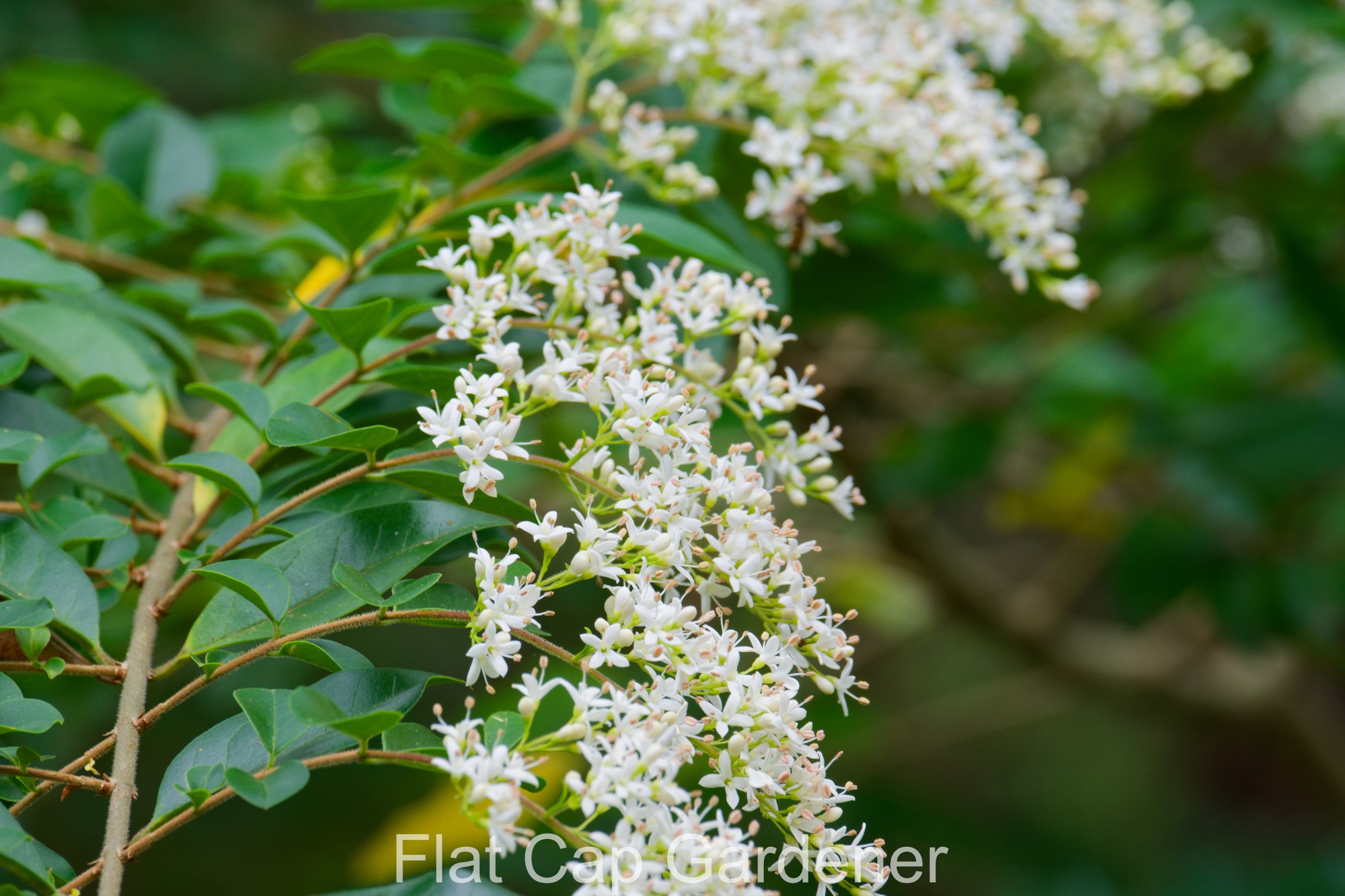
Small-leaved privet, or Ligustrum sinense, is a small tree native to China. In height, it rarely gets taller than three metres. this privet species was introduced into Australia as an ornamental plant, especially as a plant for hedging. It is now considered a fairly major weed, as it is classified as an environmental weed here in New South Waless and also in Queensland. In both the Australian Capital Territory and Victoria, it is a potential or emerging problem.
Before talking about why it’s a weed and what its preferred habitat is, here is a little information on what it looks like. While it is usually around three metres tall, it can reach as tall as four or five metres occasionally. The bark of trees is grey, but younger stems can be green and hairy. The leaves are up to seven centimetres long by three centimetres wide. They are arranged in an opposite arrangement along stems. Their leaf margins (edges) are wavy. They can be hairy, more so on the leaf underside. Flowers are white with four petals. The flowers appear in dense clusters at the ends of branches. Fruits follow the flowers. The fruits are rounded and berry-like-botanically they are a drupe, like an avocado. They start green and turn purple-black when mature.

The preferred climates of the small-leaved privet are tropical, sub-tropical and warm temperate. It really does very well in Sydney. Since becoming naturalised, it has resided in rainforests and open woodlands, along roads and waterways, in urban bushland and disturbed sites, as well as being found in wasteland areas disturbed sites.

So the question is, why is small-leaved privet a weed? It spreads easily through the fact that birds and other animals eat the fruit and deposit the seeds elsewhere as they move around their habitats. When its starts to grow, it has the ability to form dense thickets that outcompete native plant species. It does become a mass of privet and other plant species, if it is allowed to get out of control-something that I have seen a few times unfortunately. When this occurs, it obviously changes the habitat available to native animal species, reducing available food and habitat for them.

As well as reducing habitat for animals, the flowers and fruit are poisonous to both humans and livestock. For some people, the flowers can cause an allergic reaction. In poultry, there is a toxin that can cause seizures apparently.
As with any sort of weed, dealing with it sooner rather than later is always best practice. Even with large infestations-if you don’t make a start, there will never be any progress! If you find a seedling or two in your garden, remove them immediately to save hassle later! In bushland, if there are one or two trees dotted through it, remove those individuals as found.
On doing some reading around this best way to deal with large infestations that resemble thickets, bulldozers are a useful tool to aid removal. Manual removal is of course possible, but is more time-consuming! For any areas where this privet is removed, revegetate with plants native to the area. Management is needed for several years afterwards due to the seed bank in the soil. Any privet seedlings that come up after revegetating the area need removing. If not there is no point in removing the privet thicket in the first place! Good land management is very important anyway, especially where weeds like small-leaved privet is concerned!
Fire has nil impact on the level of infestation-the privet plants can regenerate after fire. With mature trees, chemical control can be used, but again, this can be very time-consuming for large infestations with many mature trees.
So, in summary, small-leaf privet is a thug here on the east coast of Australia. If a specimen of this species is found in the garden, remove it straight away. If a large infestation is found, report it to the local council or national park service. Ask what they are doing about it and keep asking, to keep them accountable for managing their land appropriately!
https://weeds.org.au/profiles/chinese-privet-narrow/