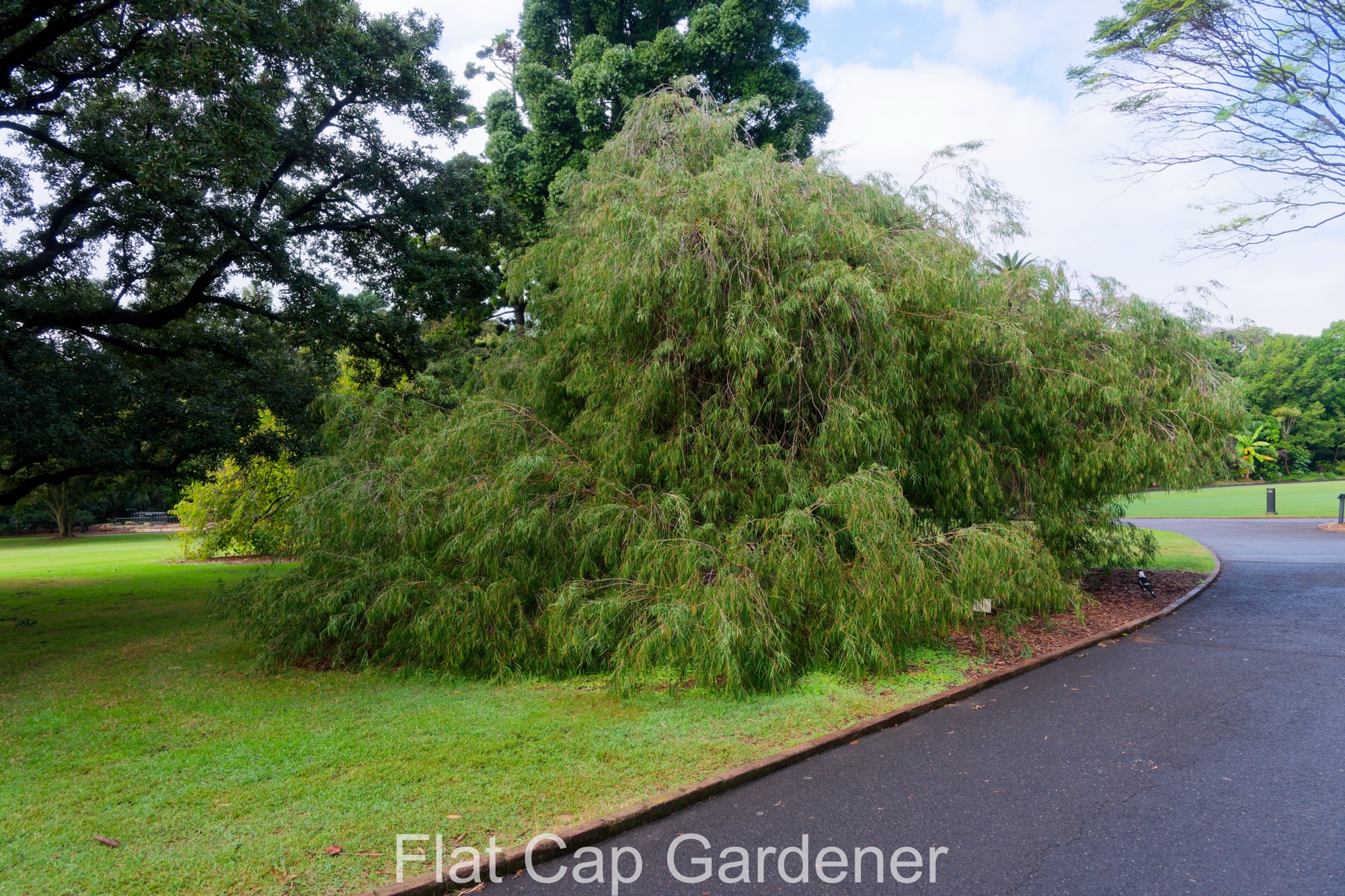
The willow myrtle, or Agonis flexuosa, is a tree coming from the coastal districts of the southern parts of Western Australia. It is in the Myrtaceae family. Mature trees have a weeping habit, bit like willow trees, hence the common name. The binomial name, Agonis flexuosa, has the following meaning:
- Agonis-comes from the Greek word ‘anon’ that means a gathering or cluster, referring to the group of flowers.
- Flexuosa-comes from the Latin word ‘flexuosus’ meaning bending or curving in a zig-zag way. This refers to the stems, as they appear to zig-zag.

There are three varieties of this tree that are recognised:
- Var. angustifolia haș longer, narrower leaves than the typical species
- Var. lalifolia has leaves that are both broader and shorter than the typical species
- Var. flexuosa is the typical species.
Willow myrtle usually does have a weeping habit. The leaves are lance-shaped. When crushed, the leaves have a peppermint smell. The leaf arrangement along the stems are alternate, with the stems changing direction at the point where a leaf grows (a node, and why there is the zig-zagging). The leaves can reach up to twelve centimetres long by twelve millimetres wide.

The flowers appear in spherical clusters to ten millimetres across. They are arranged along the stem. Each flower has five petals surrounding up to 25 stamens. Flowers appear between July and December, being followed by cup-shaped, woody fruits, up to five millimetres in diameter. When mature, the seeds are released through some valves in the fruit.

The maximum height of this tree is around fifteen metres, although it can be smaller in cultivation where it takes a long time to get to its full height. It is a popular tree in cultivation and is relatively happy in sub-tropical and temperate areas of Australia. It has an ability to adapt to different soil types, provided that it is free-draining. Full sun is required. The willow myrtle has moderate salt and drought tolerance once it’s established.
Propagation of the willow myrtle is by seed in the spring or autumn. Seed can either be direct sown or sown into seedling trays. It can also be propagated through semi-hardwood cuttings in early summer.

I do like the willow myrtle. It is a smaller tree so can fit into more gardens. It’s also good as a street tree and in parks. I would happily have this tree in my garden, mainly because of its weeping habit.