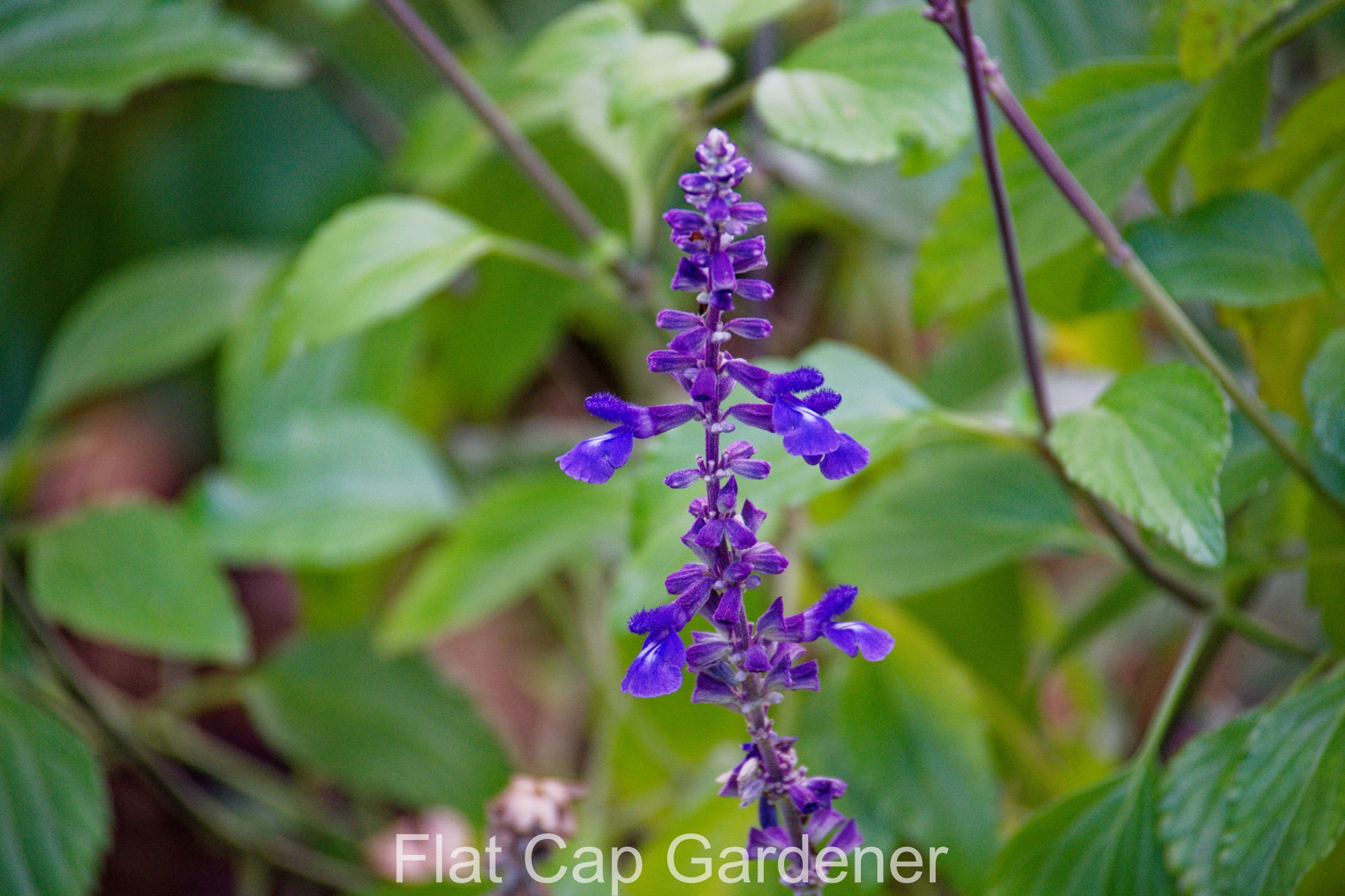
The mealycup sage, or Salvia farinacea, is another purple-blue flowering sage that I saw at Auburn Botanic Gardens a couple of months ago. In its native Mexico, Texas and New Mexico, it is perennial, but in cooler climates, it’s often grown as an annual. The common name came from ‘mealy’ which refers to the fact that the flowers are covered in a powdery meal. The cup part comes from the fact that the calyx is shaped like a cup. As for the binomial name, Salvia farinacea, there are the following meanings:
- Salvia-from the Latin word salvio, meaning to save or heal. Some of the members of the salvia genus have apparently got medicinally curative properties.
- Farinacea-comes from the Latin word farina, meaning flour or meal.This refers to the powder found on the flowers and stems.

In its native habitat, the mealycup sage lives in woodland egdes, along with plains, prairies and meadows. Soils are limestone. Elevation above sea level is apparently 1000-1800 metres above sea level.
The leaves of the mealycup sage are up to seven centimetres long. They are lance-shaped and grow in clusters from stems that are square in cross-section. The leaf margins can be serrate (toothed).

Mealycup sage flowers are purple in colour. They appear in terminal racemes from early summer until the first frost. As well as purple, they can be blue or white. Each spike is up to twelve centimetres long, being covered in the 5-lobed and 2-lipped typical flowers of the genus. The flowers do attract butterflies, hummingbirds and bees. Apparently, they smell of grapes, but I couldn’t smell anything at the time.

This pretty sage is clump forming and shrubby in habit. In height, it can be up to one metre in height. Branches can droop a little, but the one I saw wasn’t particularly so.

For best results with this particular plant, it needs full sun or part shade. It’s happy in many soils, including heavier clays and sandy soils. Once established, it can tolerate some drought. If its too wet, the mealycap sage from becomes a weak and leggy plant.
As well as being able to self seed in the garden, propagation can be done through collecting the seed and sowing yourself or through cuttings. If you sow seeds yourself, sow 8-10 weeks before you want to plant out in the garden after the last frosts have passed. With cuttings, take softwood cuttings in spring.
Other than the potential for downy and powdery mildew, there aren’t any problems with the mealycap sage.
This delightful perennial is one that would call my garden home, if I had the space available. It doesn’t get too big, has pretty flowers and can combine with other colours to be part of a showy border, which I would have if I could!