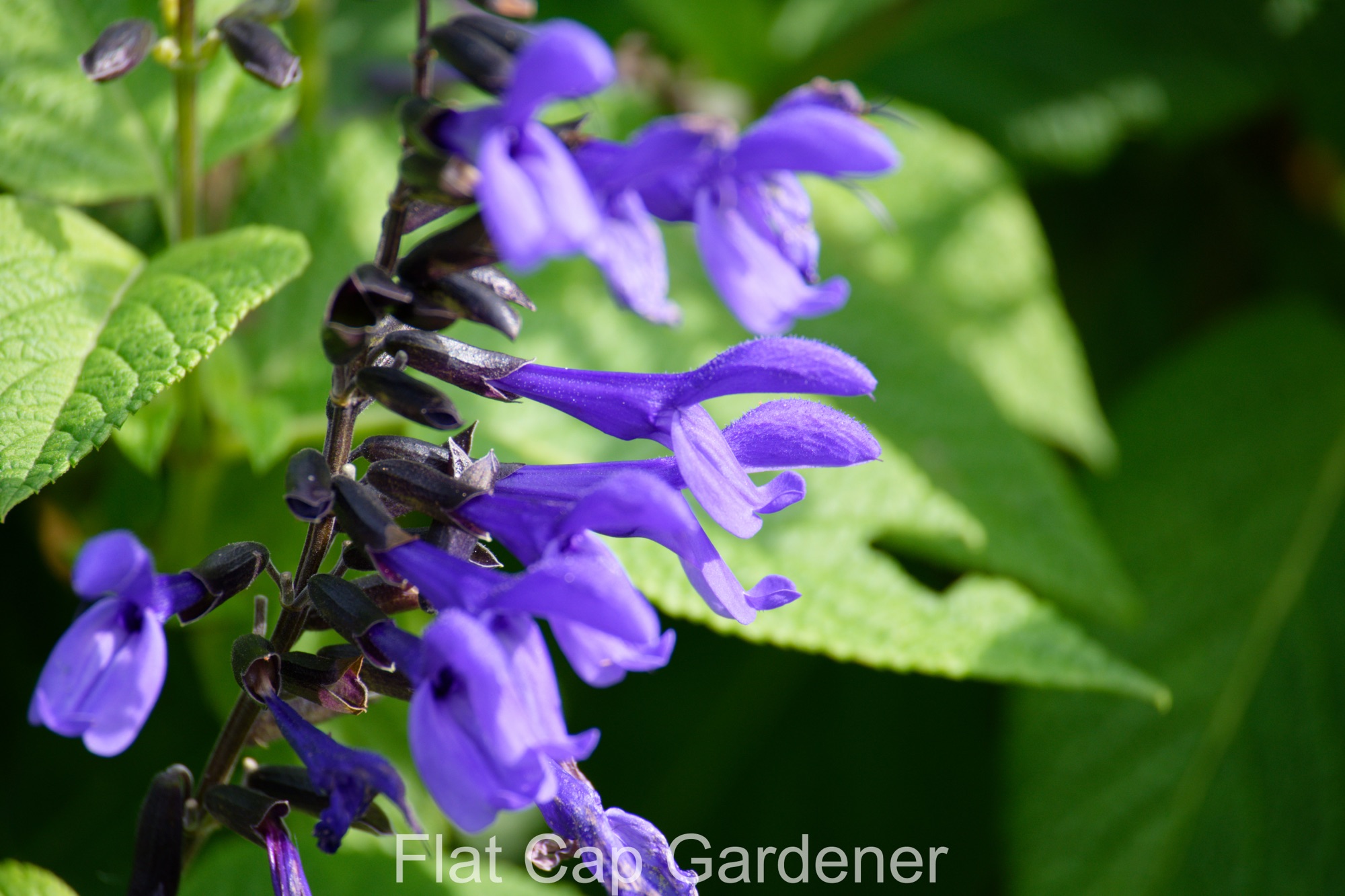
The blue anise sage, or Salvia guaranitica, is a herbaceous perennial with really nice purple-blue flowers, which is why I noticed it. This particular sage is calls several countries in South America home, including Brazil, Uruguay, Paraguay and Argentina. It reaches a maximum size of 1.5 metres tall and 60 centimetres wide. The binomial name has the following meaning:
- Salvia-comes from the Latin word salveo, meaning to heal or to save. Refers to the fact that some species in this genus are reported to have medicinal properties.
- Guaranitica-named after the Guarani people of Brazil. I have read they used the leaves as a sedative (don’t use it in this way at home, as I am no doctor).
The leaves of this lovely salvia are mid-green and up to thirty centimetres in length. The leaf margins are slightly toothed.

As with all salvias, the flowers of the blue nose sage make the plant. They are blue in colour, with their calyces having a hint of purple to them. Individual flowers are tubular in shape and arranged along the stem in one direction-usually pointing towards the sun. The flowers do follow the sun throughout the day. Flowers first appear in spring and continue until the cooler months of autumn when the plant starts to die down for winter.

The habit of the anise sage is very upright as it grows towards the sun. It is a very nice plant to have within the middle of a garden bed with other brightly coloured flowers-pinks, reds and whites have been suggested. They are also good in pots.
The cultivation requirements for the blue anise sage are that they require at lest partial shade, but full sun is also good for having a happy salvia. Soil should have moderate to good fertility. Frequent watering is needed until establishment. When it is established, this salvia is drought, as well as frost, tolerant. It copes well with heat and humidity, which it needs in Sydney’s summers! While only minimal watering is needed, this doesn’t mean no watering-check the soil when it hasn’t rained for a few days or weeks and water if it is dry. This is especially so for those planted in pots.
A word of warning about this salvia as it produces tubers that easily spread if the soil is disturbed, which gives it a potential to become a weed. For that reason, I would only recommend that this species grows in pots only.
While I think that this is a lovely salvia, I wouldn’t want this in my garden. This is because I would like it in a garden bed, but don’t want to risk having a plant become a weed. If I had a big garden to plant things in, there would be few, if any pots, around so I would have to choose another salvia instead.
https://salvias.org.au/variety/salvia-guaranitica/
https://www.landscape.net.au/salvia-guaranitica/
https://www.missouribotanicalgarden.org/PlantFinder/PlantFinderDetails.aspx?kempercode=a605