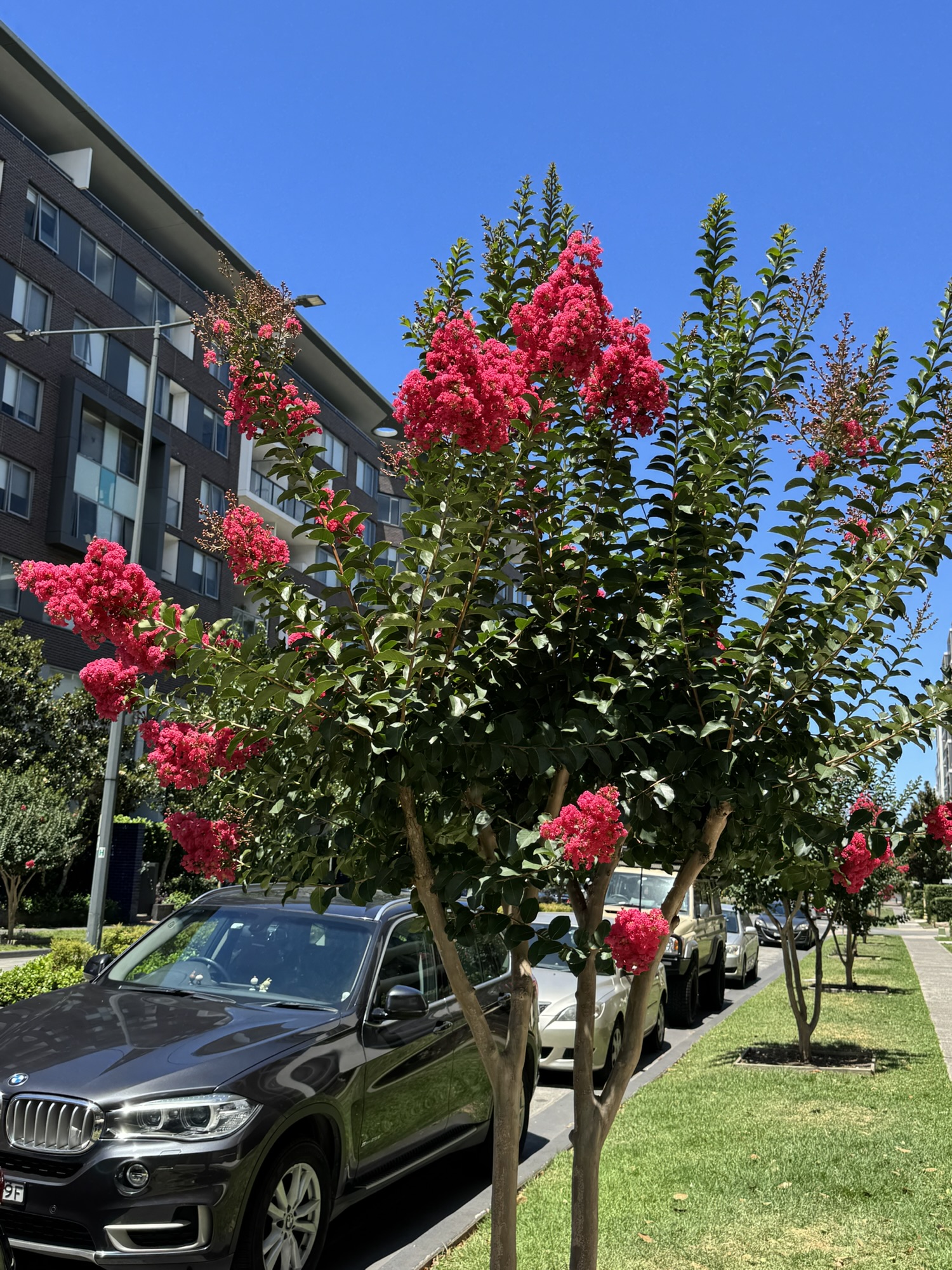
Crepe myrtles, or Lagerstroemia indica, are a delightful tree to have around in the middle of summer when they are in flower, as they are so bright and colourful in the landscape. They are a very popular tree here in Sydney, even though they are native to Asia. The common name, crepe myrtle, crepe myrtle comes from the fact that the flowers have the appearance of crepe paper (a common feature of craft projects when I was a kid) and the fact that the bark has features similar to the myrtle tree, Myrtus communis. With the binomial name, Lagerstroemia indica, the meanings are as follows:
- Lagerstroemia-used to honour Magnus von Lagerstroem (1691-1759). He was a Sweedish botanist, the Director of the Sweedish East Indies Company and also a friend of Carl Linnaeus.
- Indica-apparently from both Greek and Latin that means from, or connected to, India. It can also mean that plants can come from the East Indies or China, which is the case with our tree in question today.
The crepe myrtle is a deciduous tree or large shrub with dark green leaves that are roughly oblong in shape. They can be up to eight centimetres long. The leaves appear in spring-they are often bronze when young. In autumn, the leaves put on a good show in autumn as they turn red, orange and yellow before they fall.

The flowers are the main reason why this tree is planted, especially as a street tree. Depending on the cultivar, the flowers can be any variation on pink, red, white, purple and mauve. Whatever the colour, the flowers have crimped petals and appear in large panicles up to twenty centimetres long.


The flowers are followed by fruits that are round, brown, dehiscent and six-capsuled. While they can look quite pretty when still on the tree, once the seeds fall off the tree, they do make a mess and are a potential trip/fall hazard for some.
The bark is often a nice feature on crepe myrtles too. They often have mottled, smooth bark. It is pinkish-grey to pale brown and gets shed yearly, which also adds nicely to the effect.
In terms of the best growing conditions for the crepe myrtle, it is best in a sub-tropical or warm temperate climate. It loves full sunshine and requires moist but free draining soil. In Sydney, these trees are happy to survive on the rainfall we naturally receive. They are a very good as street trees and within gardens, adding a very nice bright colour in the summer and autumn.
Naturally, crepe myrtles want to be a multi-stemmed tree. In cultivation, they are grown as single-stemmed specimens. As a result, there is a lot of attention paid to removing the shoots/suckers from the base of the tree and its root system. Pollarding (read here) is also carried out more often than not in the autumn is another maintenance task carried out. I have a little bit of a bug bear about this tree, mainly because pollarding is so ugly once it is done with this tree. I will write about this in another blog post, so I can explain my views on the topic!
Either way, I do love having the tree around in Sydney because it is so bright and colourful, as well as being really tough and easy to care for here. Given the space and choice, I would have many of these trees in my garden and have as many different flower colours as possible!
https://www.missouribotanicalgarden.org/plantfinder/plantfinderdetails.aspx?taxonid=282496
https://bie.ala.org.au/species/https://id.biodiversity.org.au/node/apni/2896871
RHS A-Z Encyclopeadia of Garden Plants, 4th Edition, Christopher Brickell