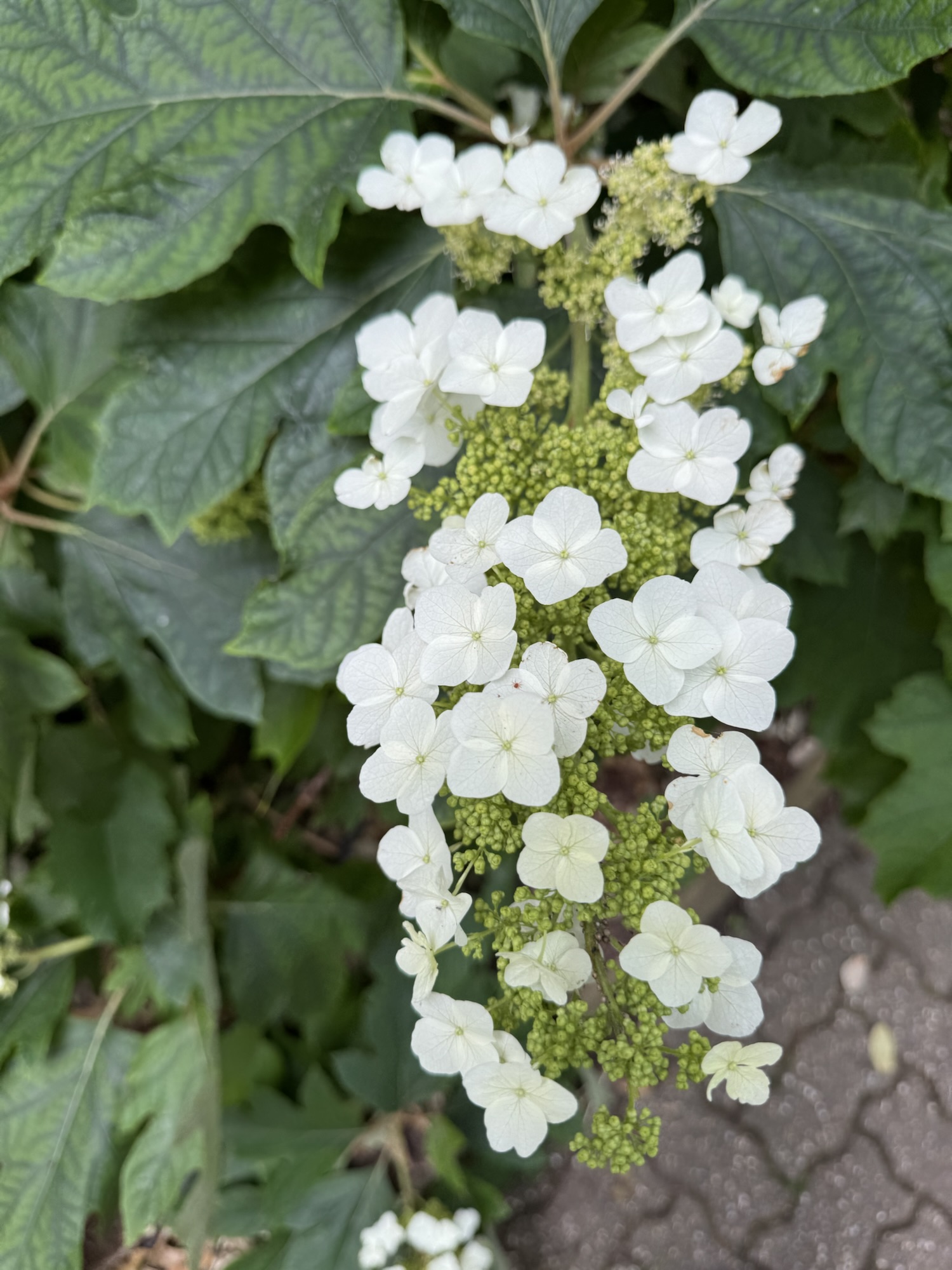
The first place I came across the oak-leaf hydrangea at Kew Gardens earlier this year and thought it was a delightful plant as it was in full flower at the time.

The oak-leaf hydrangea comes from south-eastern USA, specifically from the state of Georgia down to Florida and Louisiana. The native habitats of this multi-stemmed shrub are bluffs, ravines, moist woods and stream banks. This hydrangea can reach up to two metres tall and wide, but varies a little by cultivar. The binomial name of this plant has the following meaning:
- Hydrangea-comes from two Greek words, ‘hydor’ which means water and ‘aggeion’ which means vessel, referring to the capsule-shaped fruits of the plant.
- Quercifolia-Latin for leaves that look like oak leaves (which are in the genus Quercus).
The leaves have between five and seven lobes each. They are a mid-green colour and can reach twenty centimetres long. This hydrangea is deciduous-in autumn, the leaves turn to a purple-bronze colour before falling.

While I like the leaves, it’s the flowers that are the reason for growing this hydrangea. The shrub flowers in summer and bears conical panicles of white flowers, some of which are fertile, others are sterile. The panicles can reach up to 25cm long.

For the best flowering, the oak-leaf hydrangea needs plenty of sun, but does need protection from strong afternoon sun and strong wind. Soil needs a to be moist but well-drained, with plenty of organic matter. As a word of caution, this hydrangea does not like permanently wet soil, which can cause root rot and/or fungal diseases, which is why the good drainage is important. There is also a preference for a slightly acidic soil, but can ‘tolerate’ a range of pH. To help keep the soil moist, especially in summer, ensure there is a layer of mulch over the roots-this will also add organic matter to the soil as it rots down.

To propagate this hydrangea, seed or cuttings can be used, as can division. The shrub can also spread by suckering.
To maintain this hydrangea, water well in dry periods. Remove spent flowers as they appear. To keep the form of the shrub dense and rounded, prune lightly in late winter or early spring.
Beyond root-rot and fungal diseases in soil that’s too wet, slugs and snails can be an issue for younger plants-keep an eye out for them and remove as they are found. There is susceptibility to leaf blight and powdery mildew-ensure there is some airflow around the plant, without exposing it to strong winds. Aphids and spider mites can make the odd appearance.
The oak-leaf hydrangea is often used as an accent plant, as a mass planting in shrub boarders. The branches can also provide texture over the winter. As much as it can be helpful to provide ‘planting suggestions’ for any plant, I am of the view that you can throw those out of the window too. Provided you have the conditions for any plant you like to be able to thrive in your garden, then crack on and grow the plants that you love-it’s your garden after all!
Personally, I love this hydrangea, and would happily have one in my garden if I had the space.
https://www.missouribotanicalgarden.org/plantfinder/plantfinderdetails.aspx?kempsercode=d380
https://www.abc.net.au/gardening/how-to/plant-profile-oak-hydrangea/105105570. Written by Jane Edmunson for ABC Gardening Australia