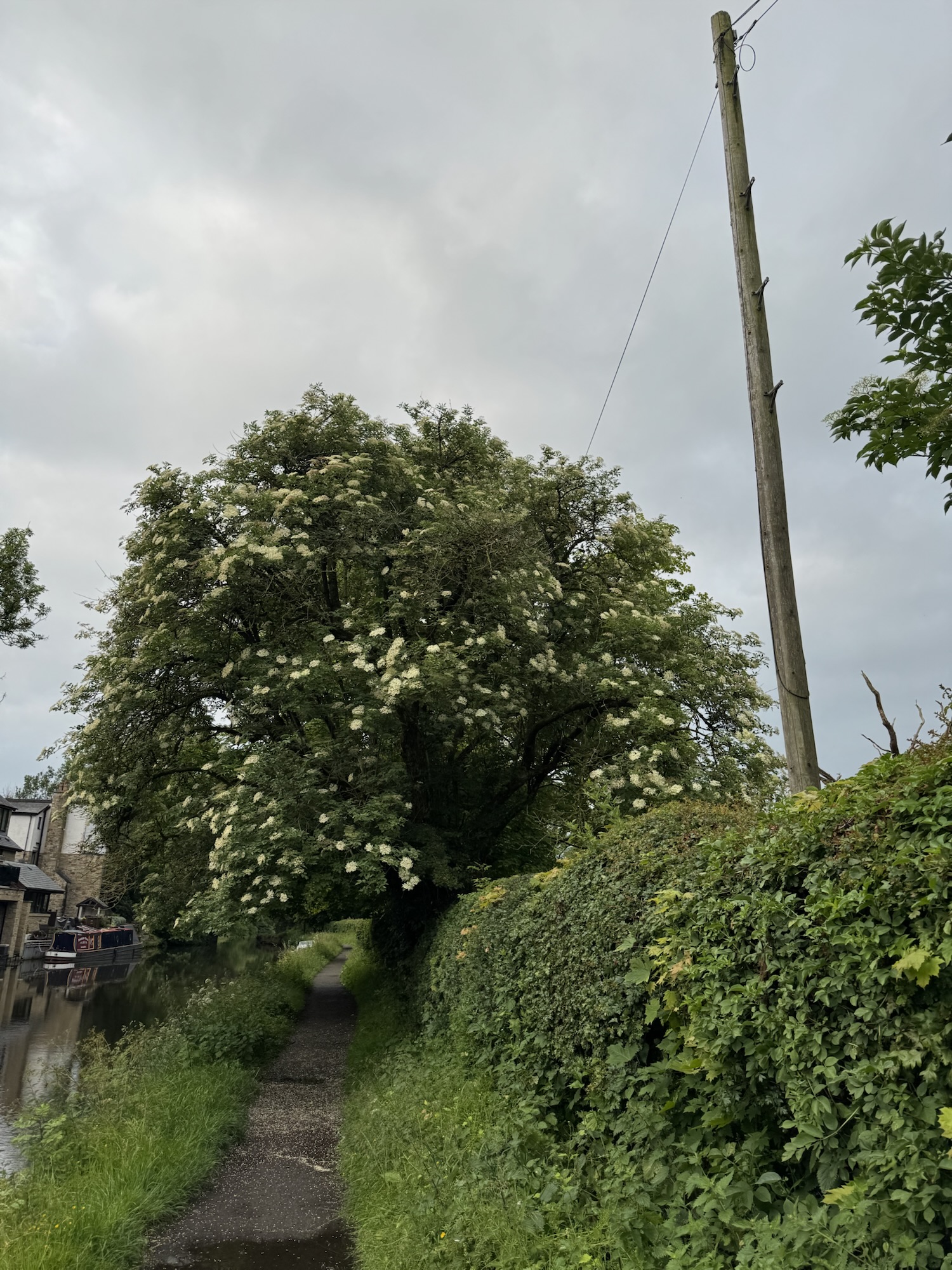
Black elder is one of those trees that is such a reminder of my childhood-especially of walks along the canal and through the local woods, both of which I loved doing. It is a native of Europe, North Africa and south-west Asia. Black elder is a deciduous shrub, that can reach up to five metres tall. As always, here is the meaning of the binomial name:
- Sambucus-Latin for ‘elderberry’
- Nigra-Latin for black
The leaves of black elder are pinnate that can reach 25cm long-each leaf has five ovate leaflets that have toothed margins (leaf edges), and are mid-green in colour.

The flowers appear in an inflorescence, the whole of which reaches 20cm long. The white flowers appear in early summer, which is when I saw them in June. The flowers have a musky smell, which took me straight back to my childhood as I walked past, along with the sight of them. The flowers are followed by round, glossy black fruit that reach 8mm across.

Happy in most soil and situations, black elder does grow well on chalk and also in heavy clay soil but prefers to grow in moist, loamy soil. It fruits best in full sun (it tolerates some shade, but when a plant tolerates something, it isn’t the happiest it could be). Black elder is also tolerant of atmospheric pollution and coastal conditions.
The shrub has a role to play in nature as it is classed as a ‘pioneer plant’-it is one of the first to colonise an area of derelict or disturbed land, often ‘deposited’ there by birds who have eaten the fruit.
There has been a long history of use in folk mediicine and food. It is also important to note here that the leaves and stems are poisonous, with the toxins in fruit apparently destroyed on cooking-so if you are unsure, don’t do anything with it. The fruit, after cooking, has been used as a flavouring in jams and preserves, pies and wine.
The seed of black elder can be sown as soon as it is ripe in autumn-sow seeds in a cold frame, where it will germinate in spring. Greenwood cuttings can be taken in spring or hardwood cuttings can be taken in the autumn or winter.
Pest and disease problems include black fly on young shoots or leaves, with verticillium wilt also being a potential problem. The good thing about black elder is that it is resistant to honey fungus, which is a bonus in my book!
Coming across black elder on a walk along the canal when I was visiting the town I grew up in was a really nice experience-the smell and sight of the flowers were the highlight of my walk. It just goes to show that no matter how far you go (in my case Australia), certain plants take you straight back to your childhood home.