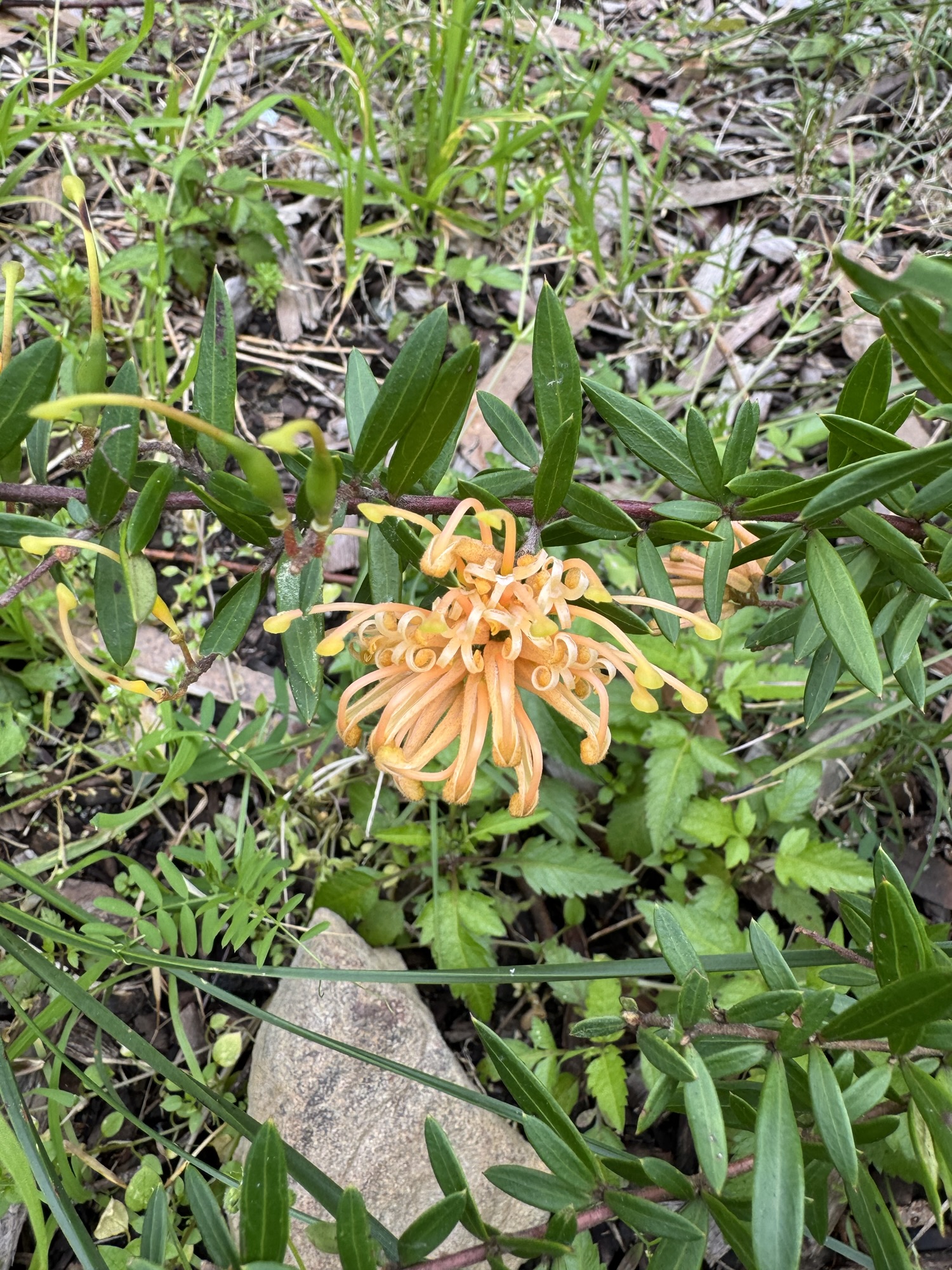
Time and again, I hear that ‘Latin’ names are an irrelevance to modern gardening because they are ‘hard to learn, pronounce and spell’. That’s just some of the people that I’ve worked with in the past, never mind people who don’t want anything to do with gardening!
For an individual plant, the name is composed of two parts. The genus is the first part of the name, written with capital letter. The genus is a group of closely related plants, like Angophora. The second part of the name is the individual species within the genus, for example Angophora costata.

Why do Latin names get used? There are several reasons for using these ‘irrelevant words’. The first one is that they actually prevent confusion. A good example is a plant called a blue bell. In my native country of birth (England), the bluebell is a lovely woodland plant that flowers in spring-its Latin name is Hyacinthoides non-scripta. In Australia, where I now live, the plant commonly called a blue bell has the Latin name of Wahlenbergia stricta. In Spain, there is another plant called a bluebell too, this has the Latin name of Hyacinthoides hispanica. This is why Latin names are important-people know exactly what species you are talking about, which then leads to knowing what the care and growing requirements are for that species too-this is always relevant and important information.
It is also good to know the Latin names when you are talking to someone from a foreign country, especially one where the language is different to the one you speak. The Latin names of a plant under discussion would be the same, no matter whether you were speaking Welsh, Mandarin Chinese or French. With many people travelling the world, whether for business or pleasure, they can understand at least the name of any plant if the Latin name is used.

The names also give us information on one aspect of the plant in question, including colour, plant form, plant features and even after people. Some examples include:
- Cinereus-the colour of ash
- Densatus-compact, dense
- Laetiflorus-with bright flowers
- Littoralis-growing by the sea
- Effusus-spreading loosely (habit)
- Juniperifolius-leaves like a juniper (whose genus name is Juniperus)
Latin names have a habit of getting changed quite frequently. Some of this is because some plants have been given Latin names more than once-the name given first, is the one that is ‘official’. With modern science, the DNA of plants can be analysed which shows how plants are related to each other-this confirms many plants as being related, as well as showing where they aren’t (and throws up some surprises along the way). Due to the new information, plants often receive new name to reflect the fact that their DNA shows their relationships to other plants. As more plants get their DNA analysed, their Latin names will become more stable and therefore stay the same for a long time.