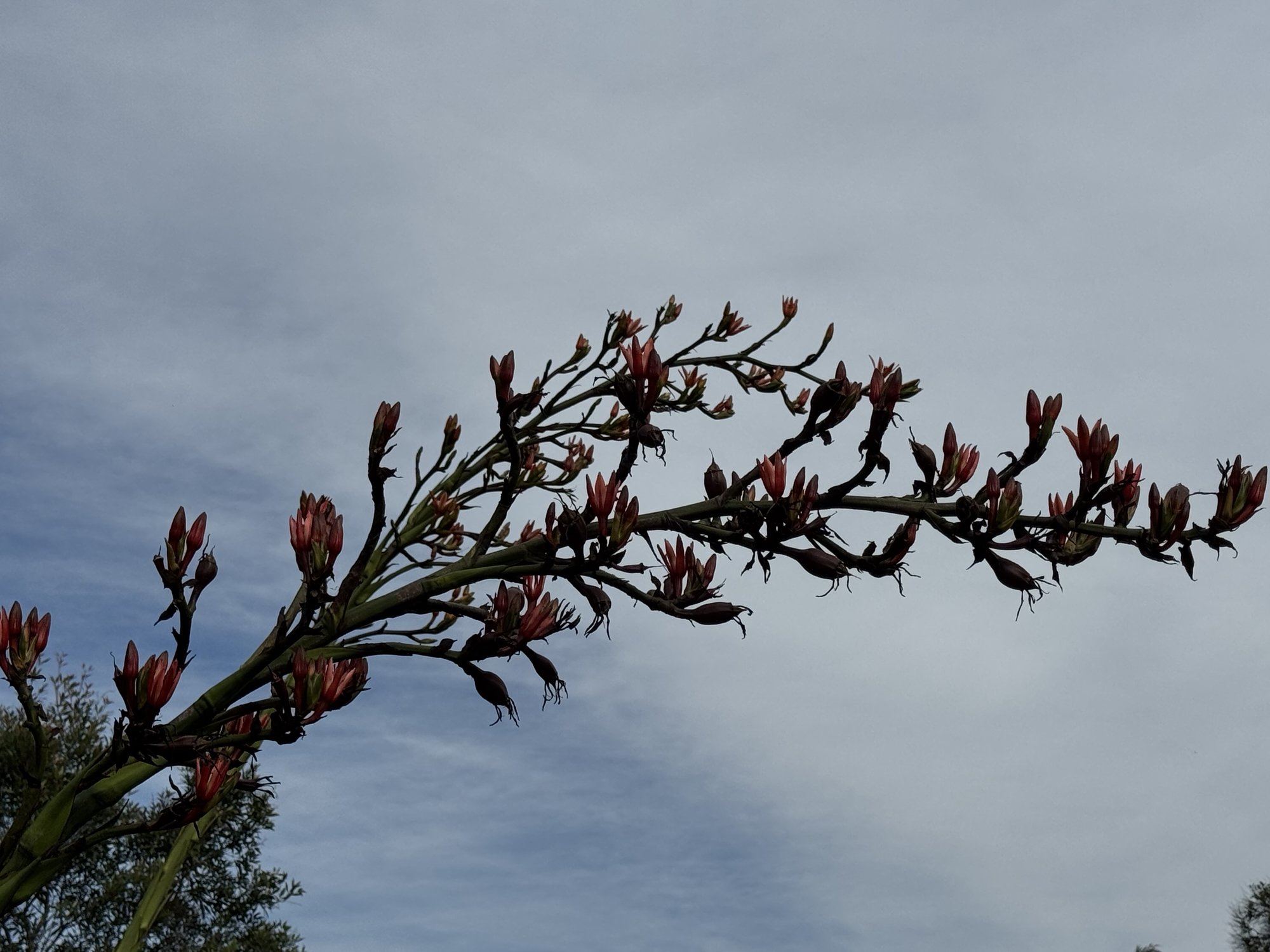
The common spear lily, or Doryanthes palmeri, is a perennial succulent that comes from north-east New South Wales and south-east Queensland. In its native habitat, the common spear lily grows in wet sclerophyll forest on rocky outcrops. It is one of two plants in the genus Doryanthes and also one of two plants in the family Doryanthaceae. As always, I like to give the meaning of the plant’s binomial name, as they can be helpful to the normal gardeners and aren’t that intimidating once the words start to become familiar:
- Doryanthes-comes from two Greek words-Doratos which means ‘spear’ and anthos meaning ‘flower’
- Palmeri-when originally named, why this was given wasn’t stated by the original author, but later references state that it was in honour of Sir Arthur Her Palmer, the Premier of Queensland, 1870-1874.
The upright then arching leaves grow in rosettes, with the leaves being lance-shaped. The leaves are ribbed which proved them with structural support.

The inflorescence appears on a scape (a flower stalk) that can reach up to five metres tall. Due to the weight of the scape, it has a habit of drooping, rather than remaining upright. The inflorescence is composed of several individual red to red-orange flowers that reach ten centimetres in diameter. These flowers are pollinated by birds who are attracted by the colour. The flowers are followed by egg-shaped fruit that are up to nine centimetres long. Flowers appear in spring. Each rosette of leaves only flowers once in its lifetime, which can take up to thirteen years. After flowering has occurred, new rosettes can be produced from the original plant.
Flowering can be earlier when there are bushfires in the area. Bushfires also encourage the sprouting of root bulbs. In a garden, earlier flowering can be encouraged by having the plant in full sun.

As a xerophyte, the common spear lily is adapted dry conditions and, as such, don’t need a huge amount of water. It is worth noting that when temperatures are forty degrees Celsius and above, the leaves start yellowing. The plant is also adaptable to soil type too, including nutritionally deficient ones, but does look better when the soil is fertile or has added fertiliser. The plant is also very useful in that it is happy in many environmental conditions, including windy areas (helped by the ribbed support for the leaves).
Propagation is through sowing seeds or the division of plants. With the seeds, it can aid germination if they are soaked in water for eight hours before sowing.
Uses within a garden setting include attracting wildlife like birds, bees and butterflies. Where you need help with erosion control and pollution tolerant plants, this may be the one for you, provided you have the space!