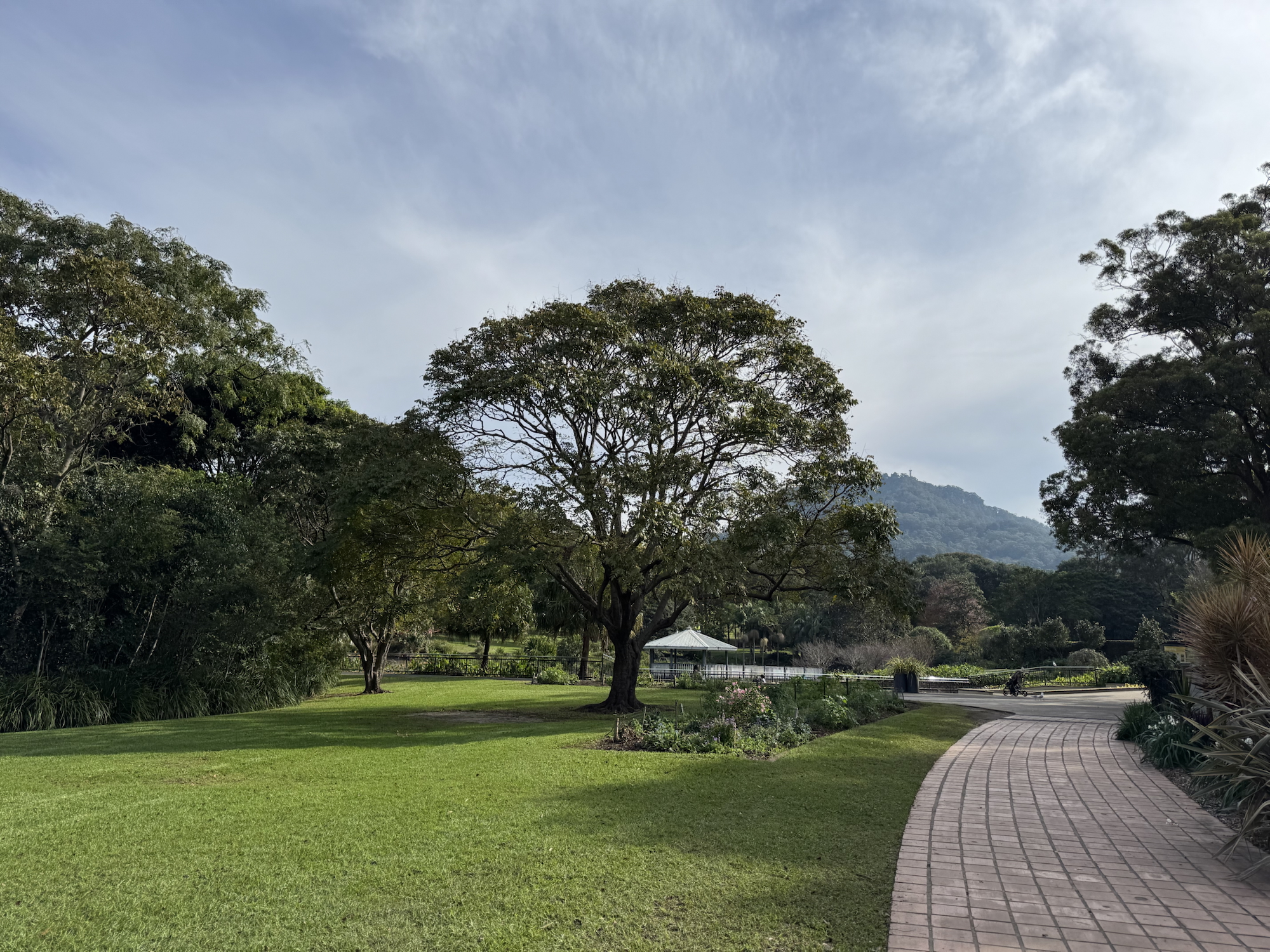
Wollongong is a city in New South Wales, Australia about one and a half hours drive south of Sydney. Last week, I went down to the botanic gardens for the day as I have wanted to visit for a while.
History
Before the arrival of Europeans, the area that is now the botanic gardens was inhabited by the Dharawal people who lived on the land for thousands of years.
Europeans arrived in the area during the 1800’s, using the land mainly for farming. During the 1950’s, the family that owned the land (the Hoskins) donated a large part of it to Wollongong City Council for the purpose of creating a botanical garden.
The process of setting up the gardens was slow over the next few decades, but with the help of volunteers, the gardens were opened in 1971. Over time, more collections have been added to the gardens to make it what it is today.
Australian open forest and grassland

This area contains open forest and grassland species. The plants come from both the Illawarra region (where Wollongong is) and the Sydney area to the north. There are both wet and dry schlerophyll forest species that show what a typical open forest looks like. There is also a sandstone area with heath and swamp plants from both the Illawarra and Shoalhaven areas.

This area has been designed so that it replicates the situation where the plants in this garden come from. The topography of this garden slopes to the north, which is the situation in which many of these plants grow. The topography is an important factor in plant diversity as it affects how winds, fire, rainfall and sun exposure all impact plants and how they grow.

The soils that these plants grow in are poor so plants grow slowly. Many plant species have adapted to this poor soil by gaining the ability to store phosphorous in plant tissues and reusing any available using nutrients. Many plants have also developed relationships with bacteria and fungi that help plants to get nutrients.

This area of the gardens started getting built in 1977, with the wet sclerophyll area started in 1980 when eucalyptus and turpentine trees were planted and now form the canopy.
What I think is great about this area is that the older trees are now mature enough to start developing hollows within their trunks. These hollows support a whole range of wildlife, including nesting birds and sugar gliders. The hollows are vital for the survival of many species, which is one benefit of having mature trees around. In time, the the hollows will increase in both size and number, allowing use by bigger animal species like the powerful owl.

I really loved this area of the gardens-it made me feel like I was actually in the bush, rather than in the middle of a small city. I love being around Australian natives-I was very happy in this area!
Azalea collection
In this area of the botanic garden, the plants come from Asia, mainly China, Japan and Korea. The main plants in this collection are:
- Azaleas
- Rhododendrons
- Camellias
- Dogwoods
- Maples
- Dawn redwoods
There are also rows of white flowering cherries (unfortunately it’s the wrong time of year for the flowers), a tea house and a bridge. There’s also a natural creek with water loving plants like iris, daylily, flax, arums and swamp cypress trees.


While I enjoyed walking through this area, it wasn’t my favourite. This is mainly because azaleas and rhododendrons aren’t my favourite sort of plants rather than the garden being rubbish.
Australian arid collection
This area is home to the plants that come from inland areas of the country, where rainfall is under 500mm per year. As Wollongong has an average rainfall of …………..mm per year, mounding of soil has taken place so that the drainage is improved.
Plants that have evolved to survive these dry conditions where droughts and extreme temperatures are fairly common, as are saline soils and fire, so these plants are tough. Adaptions include:
- Roots that can store water
- Leaf adaptions-including spiky, tubular and leathery leaves.
- Stem modifications like the ability to sprout new shoots from the stem.
- Strong seeds, where the seeds have hard coatings to allow them to survive until conditions are conducive to germination as one example.
- Adapting their growth-speeding up growth and flowering when conditions are good and slowing growth when conditions are poor.
This area is also great, again because it’s full of interesting native plants. The wildlife was also enjoying this area, especially the birds!
Rainforest collection
Another fabulous area for me was the rainforest garden. What I like about this area is that it feels like it has been left to develop naturally into what it is. Some trees in this area are remnant trees, meaning they are trees that are part of the original vegetation on that exact spot, which is even better to me-these trees are turpentines and paperbarks.
As well as having Illawarra native, there are rainforest species from tropical Queensland, New South Wales, Lord Howe Island (all Australian) and New Caledonia because they are happy in the Wollongong climate. Trees native to the are also include Illawarra socketwood (Daphnandra johnsonii) and Illawarra zieria (Zieria granulata), whose populations have been reduced due to logging or land clearing in the past.
Again there is another creek running through here, along with ground cover, shrubs, ferns and epiphytes. There are also many vines in this area.
Planting was started in 1978, with regeneration works starting in 1981 where lots of Illawarra native plants planted in this area.
Rainforests need certain conditions to thrive:
- High annual rainfall
- Nutrient-rich soils that are also well-drained and deep
- Plants are usually evergreen with a large leaf surface are to catch the light
- Plants need shelter from westerly winds, they thrive in south-easterly aspects where moisture loss from wind is reduced.
Succulent garden
This is another area that I loved, mainly because succulents are really odd looking and different to the plants I find in Australia and in England. All the shapes and colours are so interesting, along with how they have evolved to deal with dry and hot conditions that they live in.


Many succulents come from the America’s and Africa. The collection in this botanical garden includes plants from the following genera:
- Aloe
- Euphorbia
- Crassula
- Sedum
- Agave
- Mesembryanthemum
- Yucca
- Kalanchoe
- Echeveria
This Dracaena draco, or dragon blood tree, is interesting to look at, but is also rather useful too. The red resin of the tree has been used since ancient times for medicine, as a dye, as varnish and for incense.

The shallow roots of succulents allow them to collect the little rain available to them. One way of adapting to the dry conditions is by storing water in their roots, stems and leaves. They have protective spines or thorns and have waxy or woody coatings to reduce water loss and reflect the intense sunlight thy receive.


This garden has also been mounded up with sand to ensure good drainage for the plants here. This garden was fully built by 1986.
Towri bush tucker trail
This garden was developed to allow people to learn about the uses of native Australian plants used in medicine, food and shelter within Aboriginal culture. In this garden the plants are native to the Illawarra and provide a homes for species like the eastern water dragon, kookaburra, and buffalo banded rails. The garden was named by Traditional Custodians with the name meaning ‘Learning place bounded by flowers and trees’.

There are a few sections that I missed out on seeing, mainly because I didn’t realise until after I got home and had a look at the website. These include the Sir Joseph Banks Glasshouse, the rose garden (never at its best in winter), cycad garden, flowering trees and palm garden. Missing these means I have an excuse to go back again at some point in the future!
Examples of the plants used in traditional culture include the gymea lily (Doryanthes excelsa) whose leaves are used for brushes and mats, while the roots and flowers can be roasted and eaten. Flowering coincides with whales migrating up the eats coast of Australia.


The cabbage tree palm (Livistona australis) has bark used for fishing lines, leaves for roof thatching and baskets and the growing tip can be eaten (but does kill the plant).
Interestingly for me, the highly over-used (in gardens and landscape plantings) Lomandra longifolia, or spiny mat-rush, can be eaten too-the flowers and the white stripe at the bottom of leaves are both edible, apparently tasting like peas.
Woodland garden
This garden has a focus on trees, shrubs and bulbs from cool climates, mainly in the northern hemisphere. The ‘exotic’ trees include maples, dogwoods and magnolias. The bulbs include toad lily (Tricyrtis stolonifera) and Solomon’s seal (Polygonatum oderatum).


Again it is a lovely area of the garden, I have always loved woodlands-growing up, I used to love walking through the woods in my village in the soggy north-west of England. These days, the normality (to me) of these plants has meant that I don’t always appreciate them as I should!
Other areas
Other areas include the rose and palm gardens and the Sir Joseph Banks glasshouse. I missed the rose garden as roses are never very exciting in winter, while I completely missed the other two areas. This gives me an excuse to return to the gardens at some point in the future.


Final thoughts
This is one of my favourite botanic gardens, I really enjoyed my visit here. For a small garden, there is so much to see. It is also really well loved by the locals-there were young, old and every age in between enjoying the gardens on what wasn’t the warmest or sunniest of days.
I have also realised something on walking around this particular garden. I seem to enjoy the smaller botanical gardens a lot more than the bigger ones-my favourites are Wollongong and the Royal Tasmanian (in Hobart) botanic gardens more than the bigger ones like the one in Sydney. These smaller gardens seem to have more soul about them, they are all far less pretentious too. Don’t get me wrong, I always enjoy my time at Sydney’s botanic gardens, but it just misses something-I don’t know whether it’s the size, location or something else, but it doesn’t match the two smaller ones mentioned.